Random animal facts are better with context
A good animal fact tells you what happens, which animal it applies to, and why the behavior or body feature matters. That qualification is important. A claim that is accurate for one owl species, life stage, or laboratory condition may become misleading when it is repeated as a rule for every animal in the group.
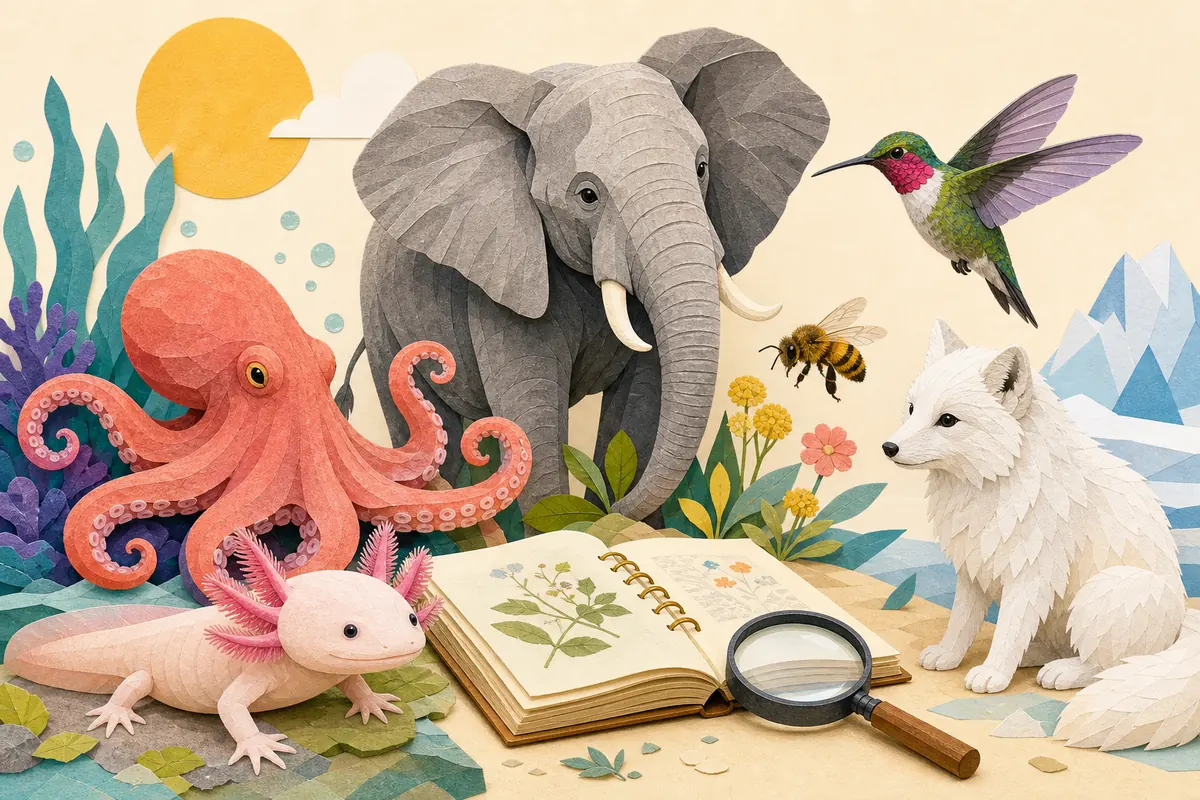
This guide collects 30 concise facts across mammals, birds, ocean animals, reptiles, amphibians, invertebrates, and record-setting travelers. Use the quick table for a fast answer, then read the numbered entries for the mechanism and limitation behind each claim. The final sections explain how to check a new fact and how to turn one into a classroom question, story idea, or drawing prompt.
Random animal facts at a glance
These six examples show the range of adaptations in the full list. Measurements and behavior can vary by species, population, and observation method.
| Animal | What makes it unusual | Theme |
|---|---|---|
| Platypus | Detects electrical signals from prey with receptors in its bill. | Senses |
| Hummingbird | Can sustain backward flight by changing the angle of its wings. | Movement |
| Octopus | Has three hearts and uses copper-based hemocyanin to carry oxygen. | Anatomy |
| Wood frog | Can survive while much of the water outside its cells freezes. | Survival |
| Honeybee | Uses a waggle dance to share a food source's direction and distance. | Communication |
| Arctic tern | Makes one of the longest known annual migrations on Earth. | Navigation |
5 random facts about mammals
Mammals share hair and milk production, yet their senses and social strategies range from underground vibration detection to cooperative tool use.
Platypus
When a platypus dives, it closes its eyes, ears, and nostrils. Thousands of electroreceptors in the bill help it detect the tiny electrical activity produced by moving prey, while touch receptors help judge position.
African elephant
Elephants can detect low-frequency rumbles and vibrations traveling through the ground. Sensitive feet and trunks help them respond to distant herd calls, storms, and other signals that people may not hear.
Sea otter
Sea otters are among the few mammals that regularly use tools. An otter may keep a favored stone in a loose pocket of skin under its forearm and use it to open shellfish.
Giraffe
A giraffe needs unusually high blood pressure to move blood up its long neck. Tight skin, strong vessel walls, and pressure-control structures help limit dangerous changes when the animal raises or lowers its head.
Dolphin
Bottlenose dolphins develop individually distinctive signature whistles. Research suggests these whistles function somewhat like names, allowing dolphins to announce or address individual identity across a group.
5 fun animal facts about birds
Bird adaptations are not limited to feathers and flight. Diet, parenting, sensory anatomy, and wind-reading can all shape how a species survives.
Hummingbird
Hummingbirds are the only living birds able to sustain controlled backward flight. Their shoulder joints let the wings rotate through a figure-eight-like stroke that produces lift on both halves of the cycle.
Emperor penguin
After the female lays a single egg, the male balances it on his feet beneath a warm brood pouch. He incubates it through the Antarctic winter while fasting for weeks.
Barn owl
A barn owl's ear openings sit at slightly different heights. That asymmetry helps the brain compare when a sound reaches each ear, allowing the owl to locate prey even in very low light.
Flamingo
Flamingos are not born bright pink. Carotenoid pigments in algae and small crustaceans are processed and deposited in feathers, skin, and beaks, so diet strongly influences adult color.
Albatross
Large albatrosses can travel huge distances with little flapping by dynamic soaring. They repeatedly cross layers of air moving at different speeds and extract energy from the wind gradient.
5 weird animal facts from the ocean
Water changes the physics of breathing, sound, pressure, and movement, producing some of the animal kingdom's most unfamiliar solutions.
Octopus
An octopus has three hearts. Two pump blood through the gills and one supplies the rest of the body. Its blood looks blue because oxygen is carried by copper-containing hemocyanin rather than iron-containing hemoglobin.
Mantis shrimp
Some mantis shrimp strike prey with club-like appendages that accelerate extremely quickly. The strike also creates collapsing vapor bubbles, so prey may experience both the direct impact and a cavitation shock.
Narwhal
The narwhal's famous tusk is an elongated tooth, usually the upper left canine of a male. It contains millions of nerve endings and can help sense changes in the surrounding seawater.
Clownfish
Clownfish live in groups organized around a dominant female. If she disappears, the breeding male can change sex and become female; another fish then matures into the breeding male role.
Humpback whale
Male humpback whales produce long, structured songs on breeding grounds. A population's song changes over time, and neighboring whales can adopt new patterns, creating a form of shared cultural transmission.
5 facts about reptiles and amphibians
Cold-blooded does not mean simple. These animals combine chemical protection, environmental sensing, regeneration, and remarkable physiological tolerance.
Axolotl
Axolotls can regenerate limbs and repair parts of the spinal cord, heart, and other tissues with far less scarring than mammals. Scientists study the process, but it does not mean every injury is harmless to the animal.
Wood frog
During winter, a wood frog can survive after much of the water outside its cells freezes and its heartbeat stops. Glucose and urea help protect cells until warming restarts normal circulation.
Chameleon
A chameleon's tongue can launch with acceleration that is especially impressive in smaller species. Elastic tissues store energy before release, helping the tongue capture prey at distances comparable to body length.
Sea turtle
Sea turtles can detect features of Earth's magnetic field. Young turtles use this information as a map during ocean migrations, and adult females can return toward the region where they hatched.
Crocodilian
In crocodilians, incubation temperature influences whether embryos develop as male or female. The exact temperature pattern differs among species, making nest conditions important to population balance as climates change.
5 surprising invertebrate facts
Animals without backbones account for most known animal diversity. Their communication, materials, and defense chemistry often inspire engineering research.
Honeybee
A honeybee returning to the hive can perform a waggle dance. The angle of the central run relates to the food's direction from the sun, while the run's duration helps communicate distance.
Jumping spider
Many jumping spiders have excellent vision for their size. Their large forward-facing eyes support detail and depth judgments, while additional eyes monitor movement around the body.
Tardigrade
When conditions become hostile, some tardigrades contract into a dry state called a tun. Metabolism drops dramatically, allowing survival through extremes that would kill an active animal; they still need suitable conditions to revive.
Butterfly
Butterflies have taste receptors on their feet. A female can sample plant chemistry when she lands, helping her decide whether a leaf is an appropriate place for her caterpillars to feed.
Bombardier beetle
Bombardier beetles store defensive chemicals in separate chambers. When threatened, they combine them in a reaction chamber and eject a hot, pulsing spray rather than carrying one permanently explosive mixture.
5 extreme animal facts about speed and survival
Animal records depend on what is measured: a dive is not level flight, a burst is not endurance, and an estimated age is not the same as a documented birthday.
Peregrine falcon
A peregrine falcon can exceed 300 kilometers per hour during a hunting dive, making it the fastest measured animal in that specific movement. Its level-flight speed is much lower.
Cheetah
Cheetahs are built for short acceleration rather than marathon pursuit. A flexible spine, long limbs, enlarged airways, and traction from semi-retractable claws support brief high-speed chases followed by recovery.
Arctic tern
Arctic terns migrate between high northern breeding grounds and southern oceans. Tracking studies reveal winding routes that can total tens of thousands of kilometers in one year rather than a straight pole-to-pole line.
Greenland shark
Radiocarbon analysis of eye-lens tissue indicates that Greenland sharks can live for centuries. Age estimates have wide uncertainty, but the species is still considered the longest-lived known vertebrate.
Wombat
Wombats produce cube-shaped droppings. Differences in elasticity along the intestine help shape the cubes, which are less likely to roll away when placed as scent markers on rocks or logs.
How to verify random facts about animals
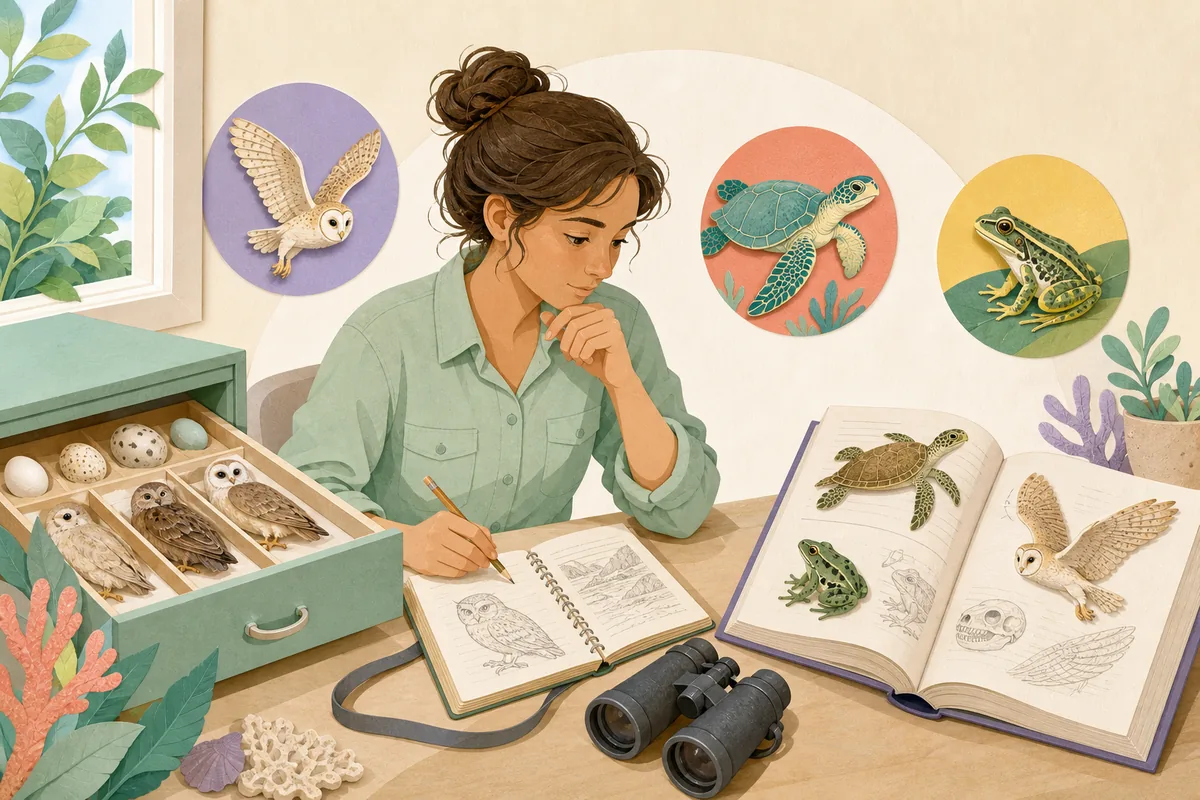
The fastest way to improve a fact is to find the original scope. Ask which species, which measurement, and which observation supports it before turning a memorable sentence into a universal claim.
- 1
Name the species
Replace broad labels such as owl, shark, or frog with the exact species whenever the source provides one. Closely related animals may behave differently.
- 2
Find a primary or expert source
Prefer a peer-reviewed paper, museum, university, zoo, aquarium, conservation agency, or government science program over an unsourced image caption.
- 3
Check the comparison
Words such as fastest, strongest, and oldest need a category and method. Note whether the record describes a dive, a short burst, a captive animal, or an estimate.
- 4
Keep the caveat
Do not remove phrases such as some species, up to, observed in captivity, or estimated. Those words often separate the accurate claim from the myth.
Ways to use random animal facts for kids and adults
A fact works best as a starting constraint rather than the end of an activity. Pair one adaptation with a question: What problem does it solve? What would change if the habitat became hotter, darker, noisier, or drier? This turns recall into reasoning without requiring advanced biology.
For a creative exercise, use the animal randomizer to choose a subject, then find one verified adaptation from this list or a trusted species page. Keep the real fact intact for a science note, or clearly label any invented extension as fiction when you build a story or hybrid creature.
- Classroom warm-up: explain the adaptation in one sentence and draw its habitat.
- Writing prompt: imagine a problem that the real adaptation would help solve.
- Drawing study: sketch the relevant body part before creating a stylized version.
- Family quiz: give the mechanism first and ask players to identify the animal.
- Fact-check challenge: compare two web claims and identify which one preserves the caveat.
Random animal facts FAQ
What is a truly random animal fact?
It is a fact selected without requiring a specific species or category. Random describes the selection method, not the reliability of the claim, so the source and scope still need to be checked.
What are some good random animal facts for kids?
Choose facts with a visible mechanism: hummingbirds fly backward, butterflies taste with their feet, and sea turtles use magnetic cues. Explain what the adaptation does and avoid frightening or overly technical details for younger learners.
Are all surprising animal facts online true?
No. Many begin with a real observation but lose qualifiers as they are reposted. Check the exact species, measurement, source date, and words such as some, may, up to, and estimated.
Which animal has three hearts?
Octopuses and other cephalopods have three hearts: two move blood through the gills and one pumps it through the body. The systemic heart slows or stops during swimming in octopuses.
Can any animal survive being frozen?
Wood frogs can survive controlled partial freezing, with ice forming mainly outside cells. That is not the same as surviving unlimited freezing, and protective sugars and seasonal physiology are essential.
How can I get a random animal to research?
Use the site's Animal Randomizer to pick a name, then confirm the common name and species through a museum, zoo, university, or conservation source before collecting facts.