Animal trivia questions are better when the answers explain why
The strongest animal trivia questions do three jobs at once: they are easy to ask out loud, they have one clear answer, and they include just enough context to stop a surprising fact from becoming a myth. That matters because animal claims often change when a specific species, measurement, or behavior gets repeated as a universal rule.
This guide is built as a host sheet. Start with the quick table, choose a category, then read the answer and the short explanation. For classrooms or public events, use the source checklist near the end before presenting a fact as science. For casual games, the explanations help players remember the answer instead of only guessing.
Animal trivia questions at a glance
Use this table when you need a fast round plan before reading the full explanations.
| Round | Best for | Example answer |
|---|---|---|
| Easy | Young players and warm-ups | Hummingbird |
| Wild | Mammals and birds | Cheetah |
| Ocean | Marine animals | Octopus |
| Weird | Surprising true facts | Wombat |
| Hard | Tie-breakers | Greenland shark |
Easy animal trivia questions for everyone
Use these warm-up questions when a group includes younger players or first-time quiz guests.
Which mammals lay eggs?
Answer: Platypuses and echidnas. They are monotremes, a small mammal group that nurses young but reproduces with eggs.
What bird can fly backward?
Answer: The hummingbird. Its shoulder joints let the wings rotate through a figure-eight stroke that creates lift in both directions.
What is the largest living animal?
Answer: The blue whale. Adults can be longer than a basketball court, though size varies by individual and population.
What animal is known for black-and-white stripes?
Answer: The zebra. Stripe patterns differ among individuals and may help with recognition, biting-fly confusion, and heat effects.
Which animal is famous for carrying its home on its back?
Answer: A turtle or tortoise. The shell is part of the skeleton, not a removable house.
Wild animal trivia questions about mammals and birds
These questions work well after the warm-up because they add one useful explanation to each answer.
Which land animal has the longest neck?
Answer: The giraffe. Its long neck helps reach high leaves, and special blood-pressure adaptations protect the brain.
Which big cat is built for the fastest short sprint?
Answer: The cheetah. Its speed comes from a flexible spine, long legs, enlarged airways, and claws that help traction.
Which bird is known for powerful silent hunting at night?
Answer: The owl. Many owls have soft-edged feathers and excellent hearing, though not every owl hunts the same way.
What animal uses a pouch to carry its young?
Answer: The kangaroo. Marsupial young are born tiny and continue developing while attached to a teat in the pouch.
Which animal is often called the king of the savanna?
Answer: The lion. The phrase is cultural shorthand; lions are social cats whose prides hunt and defend territory together.
Ocean animal trivia questions with answers
Water changes how animals breathe, move, hear, and find food, which makes this category especially memorable.
Which sea animal has three hearts?
Answer: The octopus. Two hearts pump blood through the gills and one pumps blood through the rest of the body.
What marine mammal uses echolocation clicks to find prey?
Answer: Dolphins. Echolocation helps them judge distance, shape, and movement in water where vision may be limited.
Which fish is famous for living among sea anemones?
Answer: The clownfish. A mucus coating helps protect it from anemone stings, and the partnership benefits both animals.
Which animal returns to beaches to lay eggs after years at sea?
Answer: The sea turtle. Adult females often return toward nesting regions connected to where they hatched.
What ocean animal is known for a long spiral tusk?
Answer: The narwhal. The tusk is an elongated tooth with sensory tissue, most often seen in males.
Weird animal trivia questions that need context
These are the questions people remember, but each answer keeps the caveat that makes the fact accurate.
Which animal makes cube-shaped droppings?
Answer: The wombat. Elastic differences in the intestine help shape the cubes before they are used as scent markers.
Which frog can survive partial freezing?
Answer: The wood frog. Protective compounds help cells survive winter conditions; it is not unlimited freeze resistance.
What animal can taste with its feet?
Answer: A butterfly. Taste receptors on the feet help females check whether a plant is suitable for caterpillars.
Which beetle can spray hot defensive chemicals?
Answer: The bombardier beetle. It mixes chemicals in a reaction chamber and ejects a pulsing spray when threatened.
Which tiny animal can enter a dry tun state?
Answer: The tardigrade. Some species survive extreme conditions in this inactive state, then revive when conditions improve.
Hard animal trivia questions for adults and mixed teams
Use these as tie-breakers or final-round questions because they reward careful wording.
Which animal is the fastest in a hunting dive rather than level flight?
Answer: The peregrine falcon. Its stoop can exceed 300 km/h, while normal cruising speed is much lower.
Which shark may live for centuries?
Answer: The Greenland shark. Age estimates from eye-lens tissue suggest extraordinary longevity with wide uncertainty ranges.
Which insect communicates food direction with a waggle dance?
Answer: The honeybee. The angle and duration of the dance help nestmates locate a food source.
Which bird makes one of the longest yearly migrations?
Answer: The Arctic tern. Tracked routes can total tens of thousands of kilometers in a year.
Which mammal often keeps a tool stone under its forearm?
Answer: The sea otter. Some sea otters use stones to open shellfish and may keep favored tools in loose skin folds.
How to verify animal trivia answers
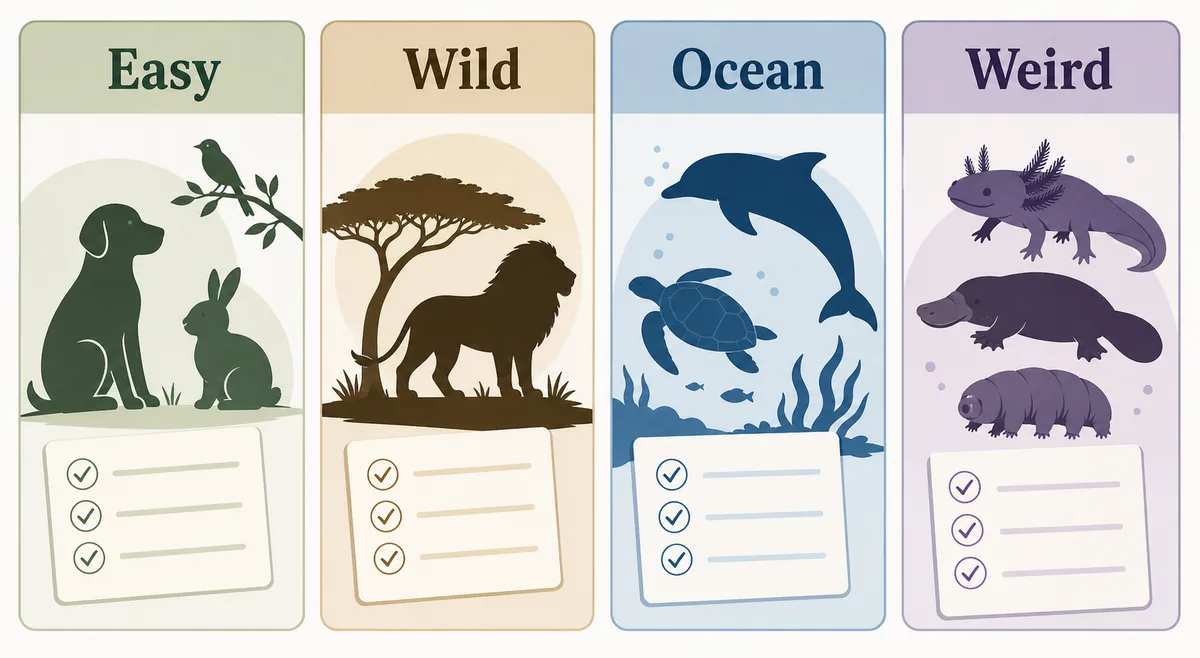
For casual play, these explanations are enough. For school worksheets, public quizzes, or science activities, take one extra minute to check the exact species and source.
- 1
Keep the species name
Avoid turning a fact about one species into a claim about every animal in a group.
- 2
Check the measurement
Fastest, largest, oldest, and longest all depend on how the record was measured.
- 3
Prefer expert sources
Use museums, zoos, aquariums, universities, conservation agencies, or primary research summaries.
- 4
Preserve caveats
Words such as may, often, up to, estimated, and some species are usually part of the accurate answer.
How to use these animal trivia questions
For a family game, read only the question first and let teams write answers before you reveal the explanation. For a classroom, ask students to identify what kind of adaptation the answer shows: movement, senses, survival, reproduction, or communication.
You can also pair this page with the animal randomizer. Generate an animal, ask players to invent one trivia question about it, then check the answer with a reliable animal profile before adding it to your next round.
- Use easy questions as warm-ups.
- Save hard questions for tie-breakers.
- Turn explanations into short science notes.
- Link each round to a drawing or writing prompt.
- Check surprising claims before printing a worksheet.
Animal trivia questions FAQ
What are good animal trivia questions?
Good animal trivia questions have one clear answer, avoid vague wording, and include a short explanation so players learn why the answer is correct.
Are these animal trivia questions for kids?
Yes. Start with the easy round for kids, then choose ocean or weird questions for older players who can handle more detail.
What is the difference between animal trivia and animal facts?
A fact states information. Trivia turns the fact into a playable question with an answer and, ideally, a brief explanation.
Can I use these questions in a classroom?
Yes, but check any printed worksheet against an expert source when the question involves records, endangered species, or species-specific behavior.
How do I make a custom animal trivia round?
Use the Animal Randomizer to pick species, then write one question about movement, habitat, diet, senses, or survival for each result.