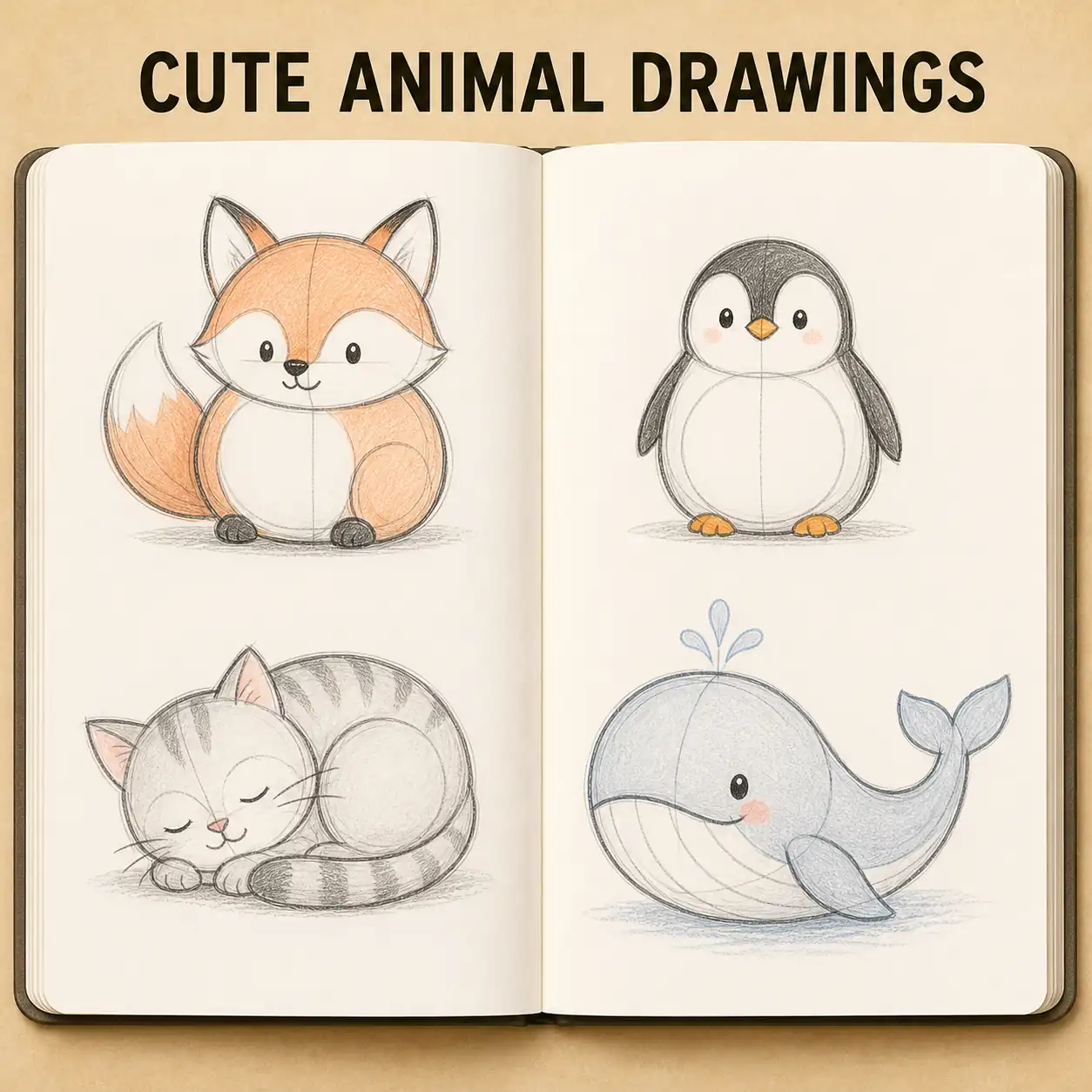
The cutest animal drawing usually has the clearest silhouette
A cute animal drawing does not need dozens of details. A large head, compact body, short limbs, one expressive gesture, and two or three distinctive features can communicate a fox, penguin, cat, whale, rabbit, or frog immediately. That is why a small thumbnail often feels cuter than a highly rendered drawing with a crowded outline.
This guide separates visual inspiration from a basic anatomy lesson. Start with the quick table, choose an animal and a pose, then use the prompt formula near the end to make your own variation. The related beginner guide covers shape-first construction for easy animals to draw; this page focuses on mood, expression, props, composition, and repeatable idea generation.
Cute animal drawing ideas at a glance
Pick a subject based on the kind of decision you want to practice. Round animals help with proportions, poses add movement, and palette prompts help a simple sketch feel finished.
| Idea family | Good subjects | Main decision |
|---|---|---|
| Round and cozy | Panda, hamster, seal, chick | Head-to-body ratio |
| Big ears and tails | Fox, rabbit, squirrel, cat | Silhouette and gesture |
| Small ocean friends | Whale, otter, turtle, axolotl | Flowing curves |
| Tiny character scenes | Frog, mouse, hedgehog, duck | Props and scale |
| Kawaii fantasy | Dragon, griffin, cloud creature | One imaginative feature |
| Sleepy poses | Cat, bear, koala, penguin | Weight and overlap |
| Happy movement | Dog, horse, dolphin, bird | Action line |
| Simple palette | Any familiar animal | Two colors plus accent |
9 round and cozy cute animals to draw
Use these ideas when you want a friendly character with a stable silhouette. Keep the center of gravity low and let the head do most of the emotional work.
1. Sleepy cat in a bread pose
Draw a loaf-shaped body, a head that barely rises above the back, and two tiny ears. Add tucked paws as short arcs and use one curved tail line to make the cat feel settled rather than stiff.
2. Round panda with a bamboo cup
Start with two overlapping circles for head and body. Place the eye patches slightly low for a gentle expression, then give the panda a small cup or bamboo stem so the paws explain the pose.
3. Hamster holding a seed
A large cheek shape can be the main design feature. Keep the ears small, place the seed between two simple paws, and let the cheeks widen the silhouette without filling the face with texture.
4. Seal balancing a ball
Use a tapered bean for the body and a round head at the front. A small ball above the nose creates a clear vertical story; two flippers and a slight lean show balance without detailed anatomy.
5. Baby chick in a shell
Draw an egg-like body peeking above a cracked shell. Two dot eyes, a tiny diamond beak, and a soft wing curve are enough. Vary the shell pieces so the bottom edge does not look like a straight fence.
6. Koala hugging a branch
Use an oversized round head, small body, and wide ears. The branch should cross in front of the lower body so the paws have a clear job. A muted gray with one green leaf keeps the drawing calm.
7. Hedgehog under a leaf
Treat the spines as one soft triangular mass instead of many separate spikes. Add a small face and a large leaf tilted like an umbrella. The overlap makes the character feel sheltered and gives the scene depth.
8. Axolotl with a tiny crown
Build the axolotl from a long rounded body, wide head, and simple external gills. A very small crown creates a funny scale contrast. Keep the background plain so the frills remain readable.
9. Duckling in a rain puddle
Use an oval body, a low head, and a flat bill. Two puddle curves and a few falling raindrops create a scene without competing with the face. A yellow body against cool blue accents is enough color.
8 cute animal drawing ideas with expressive poses
A pose gives a simple animal a reason to exist in the frame. Draw the action line first, then place the head where the viewer should look.
10. Fox peeking over a sign
Let the sign hide most of the body and show only ears, eyes, and paws. The cropped silhouette creates curiosity. Change the sign into a welcome card, a weather note, or a tiny art prompt.
11. Rabbit reaching for a star
Use a long diagonal gesture from the feet to the raised ears. One paw can stretch toward a paper star while the other balances the body. The tall ears echo the direction of the reach.
12. Penguin sliding on ice
Tilt the egg-shaped body and draw a broad curved trail behind it. Keep the wings open like brakes, with the eyes looking toward the destination. A small scarf can emphasize motion without adding anatomy.
13. Frog with an oversized umbrella
A low crouch and two wide eyes make a frog immediately readable. Make the umbrella much larger than the body, then let one hand grip the handle. The size mismatch supplies the charm.
14. Otter floating with a shell
Place the otter on its back as a long oval, with paws holding a shell above the belly. Use water lines to support the body rather than outlining every ripple. A tiny flower on the shell adds a focal point.
15. Dog carrying a bouquet
Draw a small dog leaning forward under a bouquet that is almost as wide as its body. Keep the flowers as repeated simple circles and leaves. The uneven weight gives the walk a playful wobble.
16. Whale sending a postcard
Use the whale's curved back as a tabletop and place a tiny postcard on it. A small blowhole puff and one fin point toward the card. This is a good exercise in making scale contrast feel intentional.
17. Bird flying through a paper frame
Draw a simple frame at a slight angle and let the bird cross its opening. One wing can be raised and the other lowered. The frame turns a flying pose into a small composition instead of a floating icon.
8 cute animal drawings to vary with style and color
Once the silhouette works, change one design variable at a time. A limited palette is often more convincing than adding every color you own.
18. Kawaii forest animal sticker
Choose a fox, deer, or raccoon and give it a thick outer contour, one highlight, and a tiny leaf badge. The face should stay simple enough to read at sticker size.
19. Pastel sea animal postcard
Draw a turtle, whale, or seahorse with one pale body color, one darker outline color, and a single coral accent. Add a horizon or wave shape, not a crowded underwater scene.
20. Black-and-white ink rabbit
Use no fill color and rely on line weight. Make the ears and tail bold, then reserve small hatching marks for the shadow under the body. The empty paper becomes part of the style.
21. Warm autumn squirrel
Use a chestnut body, a cream belly, and one muted orange leaf. Give the squirrel an oversized acorn so the pose is easy to read. Three colors keep the seasonal mood focused.
22. Night-sky bear
Draw a rounded bear with a dark blue body and tiny star shapes inside the ears or belly. Keep the stars sparse. The character should remain an animal first, with the fantasy idea as a surface layer.
23. Tiny dragon with a teacup
Use a compact lizard-like body, short wings, and a friendly rounded snout. A teacup beside the dragon suggests scale and personality without turning the drawing into a complex scene.
24. Animal face pattern sheet
Repeat one head shape four times and change only ears, spots, eye direction, or mouth. This makes a useful cute animal drawing practice page because comparison reveals which detail changes the mood.
25. Hybrid animal mascot
Combine one body, one face, and one surface idea from different animals. Keep the hybrid to three source traits so it stays readable. Use the Hybrid Animal Generator when you want a random starting combination.
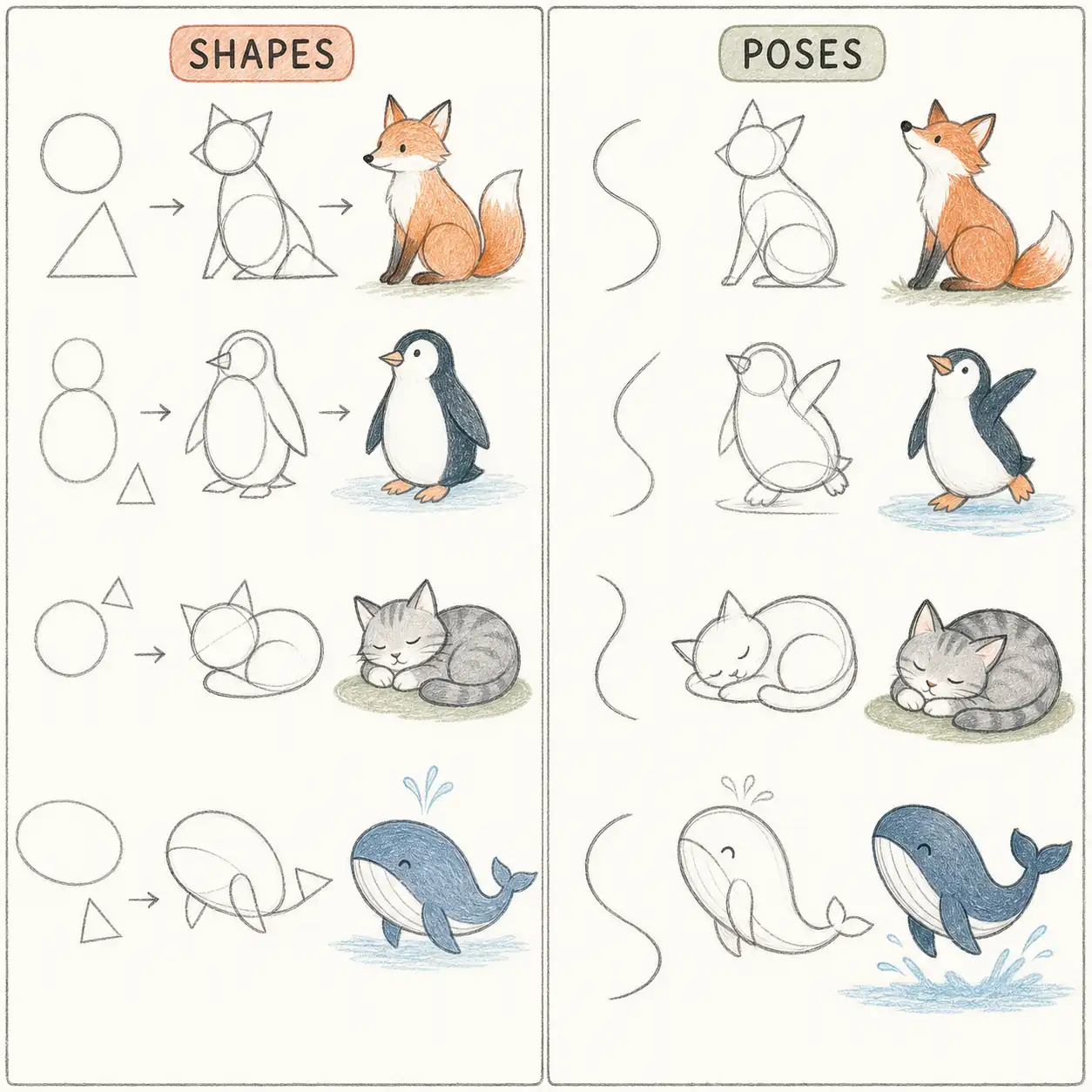
Build a cute animal drawing prompt in four parts
When a drawing idea feels vague, write four short decisions before you pick up the pencil. This gives the sketch direction without forcing a finished result.
- 1
Choose the silhouette
Name the main body shape: round, bean-shaped, egg-shaped, long, or compact. Add one exaggerated feature such as ears, cheeks, a tail, or flippers.
- 2
Choose the expression
Decide where the eyes look and whether the mouth is smiling, surprised, sleepy, or hidden. Small changes in eye height can change the entire mood.
- 3
Choose the action
Give the animal one verb: hug, peek, slide, float, carry, balance, nap, or wave. Draw the action line before adding the prop.
- 4
Choose the finish
Limit the palette to two main colors and one accent, then select one surface detail such as stripes, spots, a leaf, stars, or a scarf. Stop before the silhouette gets noisy.
A seven-day plan for cute animal drawings
Use a short routine instead of waiting for a perfect idea. On day one, draw four round animals from the first section at thumbnail size. On day two, redraw one subject with three different eye directions. On day three, take a pose from the second section and make the prop oversized, tiny, and hidden. On day four, test a two-color palette and remove one detail that does not help the silhouette.
On days five and six, open the random animal generator for drawing or the Animal Randomizer and accept a subject you would not normally choose. Make three quick versions before selecting one to finish. On day seven, compare the first and last sketches and write down one visible improvement: clearer action, better proportions, cleaner expression, or more intentional color. A dated page makes progress easier to notice than memory does.
- Keep the first thumbnail under two minutes.
- Use one action verb for every scene.
- Try three eye directions before changing the animal.
- Limit the palette before adding texture.
- Use a real reference when anatomy or behavior matters.
Cute animal drawings FAQ
What makes an animal drawing look cute?
A readable silhouette, a relatively large head, compact body shapes, simple eyes, and one clear expression usually create a cute impression. The exact ratio can vary by style, so test the silhouette at thumbnail size before adding detail.
What are good cute animals to draw for beginners?
Pandas, hamsters, seals, chicks, sleepy cats, penguins, frogs, and whales are approachable because their main forms are round or bean-shaped. The Easy Animals to Draw guide adds a separate shape-first practice sequence.
How do I draw cute animals without copying a reference exactly?
Use a reference to study proportion and behavior, then change the pose, crop, prop, palette, or expression. You can keep the animal recognizable while making the final composition your own.
Which colors work well for kawaii animal drawings?
Two soft or high-contrast colors plus one small accent are a reliable starting point. Try cream and blue with coral, brown and yellow with green, or charcoal and white with one warm highlight.
How can I get random cute animal drawing ideas?
Use the Random Animal Generator for Drawing for a structured prompt, or use the Animal Randomizer to choose a species and add your own pose, prop, and palette. Make three thumbnails before committing to one.
Should I use real animal photos for cute drawings?
Yes, especially for paws, joints, wings, fins, and how an animal sits or moves. Treat the photo as an observation reference, then simplify the result into the friendly style you want.