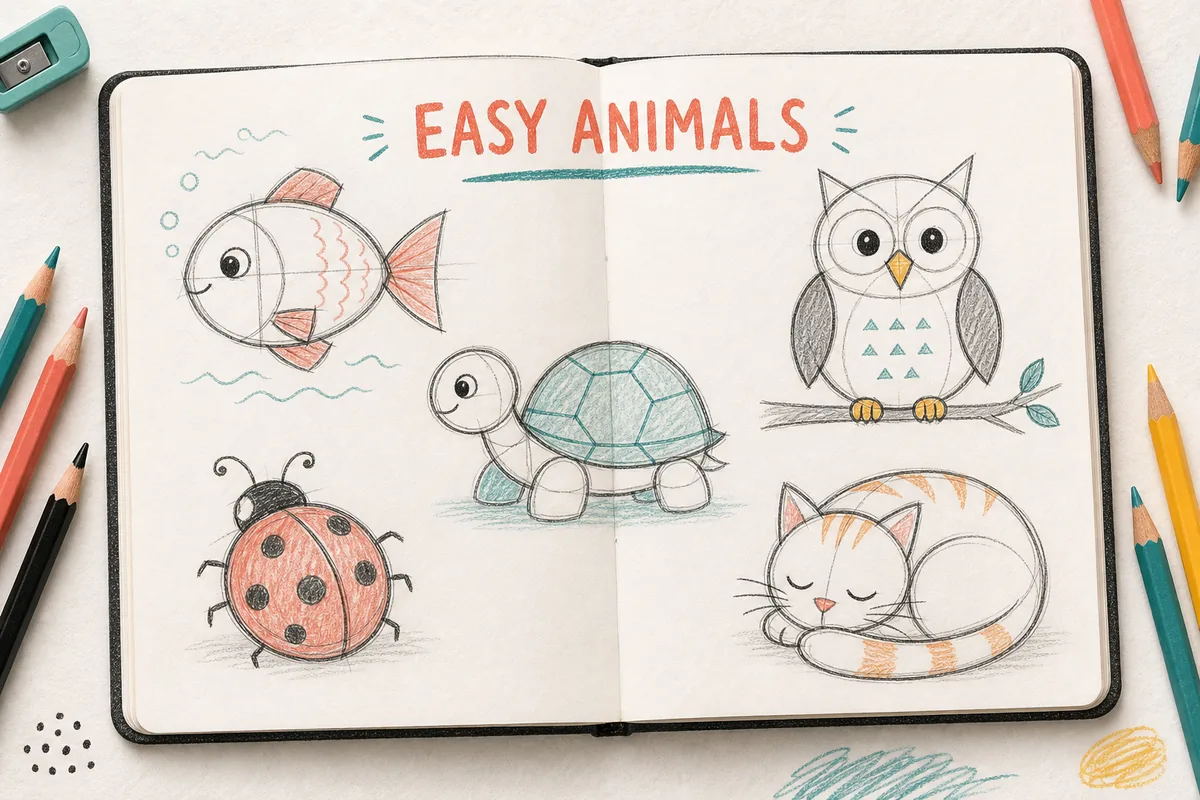
The easiest animal to draw has a simple silhouette
For a first sketch, pick an animal whose body can be described without anatomy vocabulary. A fish is an oval plus a triangle. A turtle is a wide shell with a small head and four short flippers. A ladybug is a half-circle divided down the middle. These subjects let you practice proportion and line confidence before legs, joints, and perspective become the main problem.
This guide ranks 15 easy animals to draw by the shapes they require, then gives one construction decision for each subject. The goal is not to copy a finished picture line for line. It is to understand which shapes make the animal recognizable, draw those first, and leave optional detail until the pose already reads.
Easy animals to draw by shape and difficulty
Begin with one-star subjects if controlling a pencil is still the challenge. Move to three-star subjects when you can place two body masses without repeatedly erasing them.
| Animal | Main shapes | Difficulty |
|---|---|---|
| Fish | Oval, triangle, curved fins | 1/3 |
| Ladybug | Half-circle, center line, dots | 1/3 |
| Turtle | Wide oval, small head, four flippers | 1/3 |
| Owl | Tall oval, two eye circles, wing curves | 1/3 |
| Whale | Long bean shape, tail fork, flippers | 2/3 |
| Penguin | Egg shape, belly oval, short wings | 2/3 |
| Sleeping cat | Large curl, head circle, ear triangles | 2/3 |
| Fox | Two masses, pointed muzzle, large tail | 3/3 |
5 easy animals to draw from circles and ovals
These compact subjects keep limbs short or hidden, so you can concentrate on clean proportions and recognizable features.
Fish
Draw one horizontal oval, attach a triangular tail, and cut a curved mouth into the front edge. Place the eye slightly above the center line. Add only two or three fin shapes; too many equal-sized fins make the silhouette noisy.
Ladybug
Start with a shallow dome rather than a perfect circle. Add a small head tucked beneath the front edge, divide the wing cases with one line, and vary the spots. Six short legs suggest the insect without detailed joints.
Turtle
Use a flattened oval for the shell and a smaller oval for the head. Attach four tapered flippers or blocky feet depending on the species. Draw the shell rim before any pattern so the body stays solid and readable.
Owl
Build the body with a tall oval and place two large eye circles across its upper third. A small diamond becomes the beak. Use one long curve on each side for folded wings; feather marks are optional accents.
Pufferfish
Begin with a circle and add a small tail, tiny fins, and a puckered mouth. Place short spines around the outer contour instead of filling the body with random lines. Keeping the face simple makes the round body intentional.
5 fun animals to draw in side view
A side view removes the need to match left and right sides. It is useful for learning tails, flippers, beaks, and movement direction.
Whale
Sketch a long bean shape that narrows toward the tail. Cut the tail into two broad lobes and place one visible flipper below the body. A tiny eye and curved mouth are enough; save water spray for the final accent.
Snail
Draw a spiral inside a large circle, then attach it to a low curved foot. Two long feelers establish the direction of travel. Keep the shell slightly behind the head so the overlap explains which form sits in front.
Seahorse
Use an S-shaped gesture line first. Wrap a small chest and head around the upper curve, taper the lower curve into a spiral tail, and add a simple ridge. The gesture matters more than drawing every plate or fin ray.
Penguin
Start with an egg shape tilted slightly forward. Add a smaller belly oval, a wedge beak, two narrow wings, and short feet. Plan the dark back and light belly boundary before shading.
Duck
Combine a round chest with a smaller head circle and a flat bill. A single teardrop shape describes the folded wing. Place the eye near the bill line and keep the feet broad rather than drawing every web.
5 simple four-legged animals for the next challenge
These animals add paired body masses and leg placement. Draw the far legs lighter or partly hidden so all four do not compete.
Sleeping cat
Curl one large oval into a comma shape and nest a head circle against it. Two ear triangles and a tail wrapped along the body make the pose readable. Because the paws are hidden, you can study flow without solving standing anatomy.
Mouse
Use a teardrop body, a small pointed head, two large ear circles, and a thin tail. Keep the paws as short marks under the body. The long nose-to-tail rhythm is more important than whiskers or fur texture.
Rabbit
Place a small chest oval in front of a larger hip oval. Add long ear shapes and one large folded hind leg. The back should flow smoothly from shoulders to hips; that curve communicates a rabbit faster than facial detail.
Pig
Draw a sturdy barrel body with a round head and short rectangular legs. Add a flat oval snout, triangular ears, and a curled tail. Keep the belly close to the ground to preserve the heavy, friendly silhouette.
Fox
Start with a narrow chest oval and a larger rear mass, then connect them with a flexible spine line. Use a pointed muzzle, tall ears, slim legs, and one oversized tail. Simplify fur into a few contour breaks instead of many spikes.
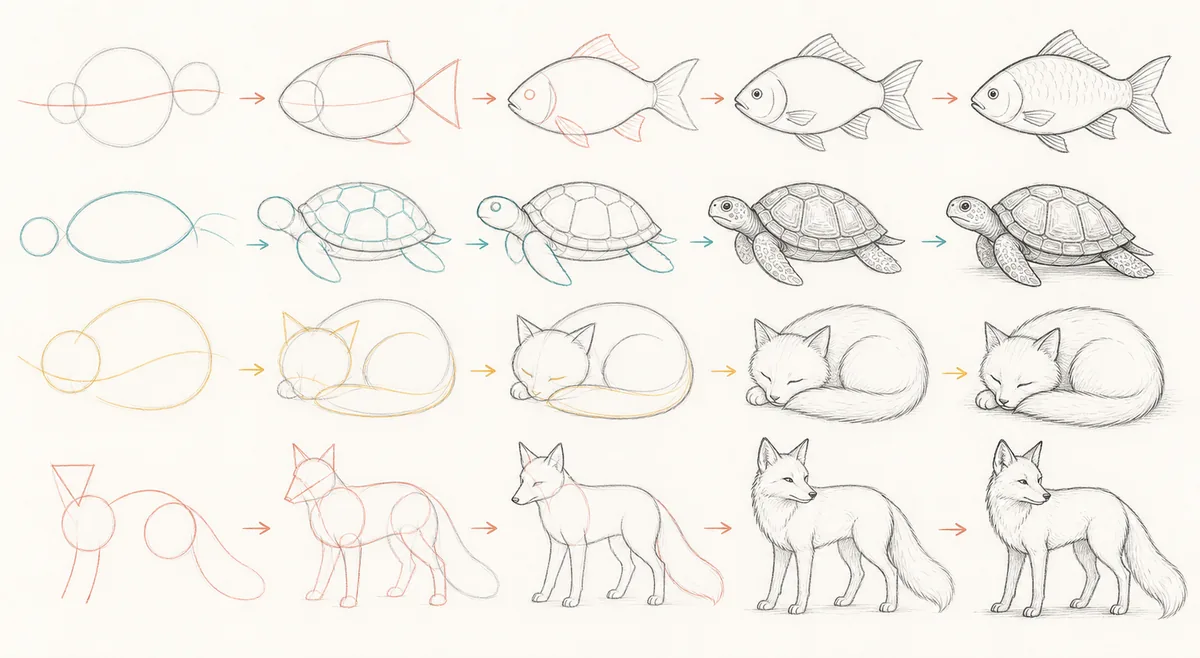
How to draw animals easily in four repeatable steps
Use the same sequence for every subject. Each step solves one visual problem, which makes errors easier to identify.
- 1
Draw the gesture
Use one light line to show the direction of the spine, swim, curl, or lean. This line describes the pose before anatomy.
- 2
Place the largest shapes
Add head, chest, hips, shell, or main body as circles, ovals, beans, or wedges. Compare their sizes before drawing eyes or texture.
- 3
Connect the silhouette
Join the shapes with confident outer curves, then place only visible limbs. Erase hidden construction lines after the contour reads clearly.
- 4
Add identity details
Choose two or three traits such as ears, beak, tail, pattern, or fins. Add texture last and leave quiet areas so the drawing does not become uniformly busy.
A seven-day animal drawing plan for beginners
Draw for ten to fifteen minutes a day rather than turning one picture into a test of talent. On days one and two, fill a page with fish, ladybugs, turtles, and owls at thumbnail size. On days three and four, use side-view animals to practice gesture and overlap. On days five and six, try the sleeping cat, mouse, rabbit, pig, and fox with construction lines visible.
On day seven, open the random animal generator for drawing and accept one subject you did not choose. Make three tiny versions before selecting one to finish. Compare the final sketch with a reliable photo reference and note one structural change for the next attempt. Progress comes from clearer observation and repeatable decisions, not from hiding every correction.
- Limit the first sketch to two minutes.
- Draw large shapes before facial features.
- Try three silhouettes instead of perfecting one outline.
- Use photo references for real anatomy and proportion.
- Keep one dated page each week to measure progress.
Easy animals to draw FAQ
What is the easiest animal to draw?
A fish is often easiest because its body is one oval, its tail is one triangle, and fins can be simple curves. A ladybug or turtle is equally approachable if you prefer a round subject.
Which animals are easiest for kids to draw?
Fish, ladybugs, turtles, owls, whales, penguins, and sleeping cats work well because their main shapes are large, distinct, and easy to repeat without precise joints.
How can I draw animals without realistic anatomy?
Begin with gesture and two or three body masses, then choose only the traits needed for recognition. Use a photo to check proportion, but simplify rather than copying every detail.
Should beginners trace animal drawings?
Tracing can help you notice proportions, but follow it with a freehand redraw from observation. Learning happens when you decide where to place shapes without the original line underneath.
How do I get random animal drawing ideas?
Use the drawing prompt generator to choose a normal animal or build a hybrid. Make three thumbnails from the text result before looking for detailed references.