Migration connects places that meet changing needs
Animal migration is a repeated movement from one area to another, often linked to breeding, food, water, or seasonal conditions. It can span a continent, connect a river with the ocean, or cover a shorter distance. There is no single minimum distance that defines every migration.
A route is more than a line between two endpoints. Animals may rely on stopovers for rest or food, and timing can shift with weather, habitat, and the needs of a particular population. A useful animal migration guide therefore compares examples carefully instead of claiming that every member of a species follows one identical schedule.
Animal migration at a glance
Use the table to connect a movement with its likely purpose and the evidence to check. These are patterns, not rules for every species or population.
| Movement or driver | What changes | Example to investigate |
|---|---|---|
| Food | A resource becomes seasonal or less available | Wildebeest following changing grazing |
| Breeding | Animals travel to a suitable nesting or spawning area | Salmon returning to freshwater |
| Temperature | Conditions make another area more suitable for part of the year | Some migratory bird populations |
| Water | Dry and wet periods change where water is available | Large herbivores in seasonal landscapes |
| Life cycle | Different stages depend on different places | Sea turtles and marine feeding areas |
| Route | A journey can include more than two locations | Stopover wetlands and coastal sites |
Why animals migrate: five recurring reasons
Migration is usually a response to several connected conditions. Food, reproduction, water, temperature, and habitat are useful starting points, but the strongest explanation is specific to the species and population.
1. Food changes by season
Plants, insects, fish, or other prey may become abundant in one region and scarce in another. Moving lets an animal use those changing resources. A food-driven explanation should identify what the animal eats and when that resource is available, rather than saying only that it follows the weather.
2. Breeding sites offer the right conditions
A place used for feeding may not be the safest or most productive place to raise young. Some animals travel to nesting, calving, or spawning areas and later return to another range. The movement is connected to a life-cycle stage, not simply a search for a new permanent home.
3. Water becomes less available
Drought, changing rainfall, and seasonal flooding can alter where an animal can drink or find aquatic food. Some movements connect dry-season and wet-season ranges. Describe the water conditions and region involved instead of assuming every population follows the same rainfall calendar.
4. Temperature and seasonal conditions change
Cold, heat, snow, ice, or shifting daylight can make a familiar area less suitable for part of the year. Some animals move as conditions change, but temperature is rarely the only factor. Check how weather relates to food, breeding, and the species' own seasonal cycle.
5. Different life stages use different habitats
Young and adult animals may depend on different places for shelter, food, or reproduction. A journey can connect nursery, feeding, and breeding areas rather than a single home with a seasonal refuge. Sea turtles, for example, use nesting beaches and marine feeding grounds at different stages.
Migration vs daily movement, dispersal, and nomadism
Not every animal movement is migration. Distinguishing the terms keeps a school report, field note, or animal migration facts page from turning ordinary movement into a long-distance journey.
6. Seasonal migration is a recurring journey
Many familiar examples involve a repeated seasonal movement between ranges. A return journey may happen later, but timing can vary among populations and years. Look for a regular pattern tied to changing resources or a life-cycle need before calling a movement seasonal migration.
7. Daily movement stays within a routine range
An animal that travels from a den to a feeding area each day is moving, but that alone does not make it migratory. Daily foraging, commuting between shelter and water, and short local trips are different behaviors. The time scale and repeated seasonal pattern matter.
8. Dispersal often changes where an individual settles
Dispersal commonly describes a one-way movement away from a birthplace or group to find a territory, mate, or new home. Migration usually refers to a repeated or population-level movement between ranges. Biology terms can vary by study, so use the source's definition when precision matters.
9. Nomadic movement follows changing conditions
Nomadic animals may move irregularly as food or water shifts, without returning on a fixed seasonal schedule. A route can still be purposeful even if it is not predictable in the same way as migration. Do not infer a repeated calendar from one observation.
Animal migration examples: birds, wildebeest, whales, salmon, and monarchs
These examples show why animal migration is not one single kind of journey. Each species has its own route, timing, population differences, and constraints.
10. Migratory birds use networks of habitats
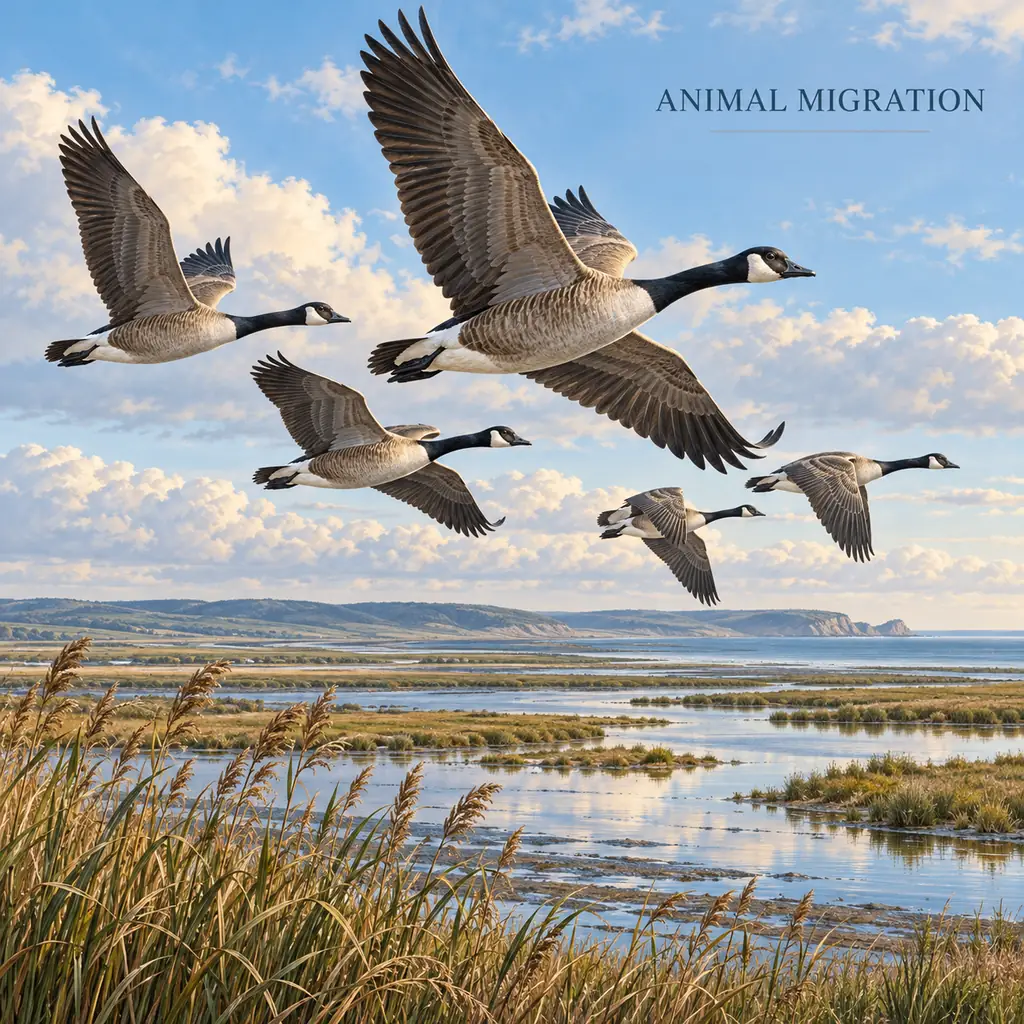
Many bird populations move between breeding and nonbreeding areas, sometimes using wetlands, shorelines, or other stopovers along the way. A broad flyway is not a single track followed by every bird. Species, age, weather, and local habitat can all change how a route is used.
11. Wildebeest migration follows a changing landscape
The Great Migration in Africa is associated with large wildebeest herds moving through parts of the Serengeti and Maasai Mara region. Rainfall and fresh grazing influence where herds travel. The phrase wildebeest migration describes a population movement, not one synchronized line or a fixed date that is identical every year.
12. Some whales move between feeding and breeding areas
Certain whale populations use different regions at different points in their annual cycle. A route may cross large stretches of ocean, and the movement can be studied through sightings, tagging, or acoustic monitoring. Whale species and populations differ, so avoid presenting one route as the pattern for all whales.
13. Salmon connect freshwater and marine habitats
Many salmon are anadromous: they spend part of their lives in the ocean and return to freshwater to reproduce. Their life cycle connects rivers, estuaries, and marine feeding areas. Timing and route vary by species and river system, and not every fish follows the same survival path.
14. Monarch butterflies move across generations
Some monarch populations make seasonal movements between breeding areas and overwintering sites. The full annual cycle can involve more than one generation, so it is misleading to imagine one butterfly completing every leg. Plants, weather, and habitat along the way all matter to the population.
How migration routes, stopovers, and navigation work
A map can make a journey look simple, but a useful route description explains where animals pause, what they need there, and which evidence supports the connection between sites.
15. Routes often have several important places
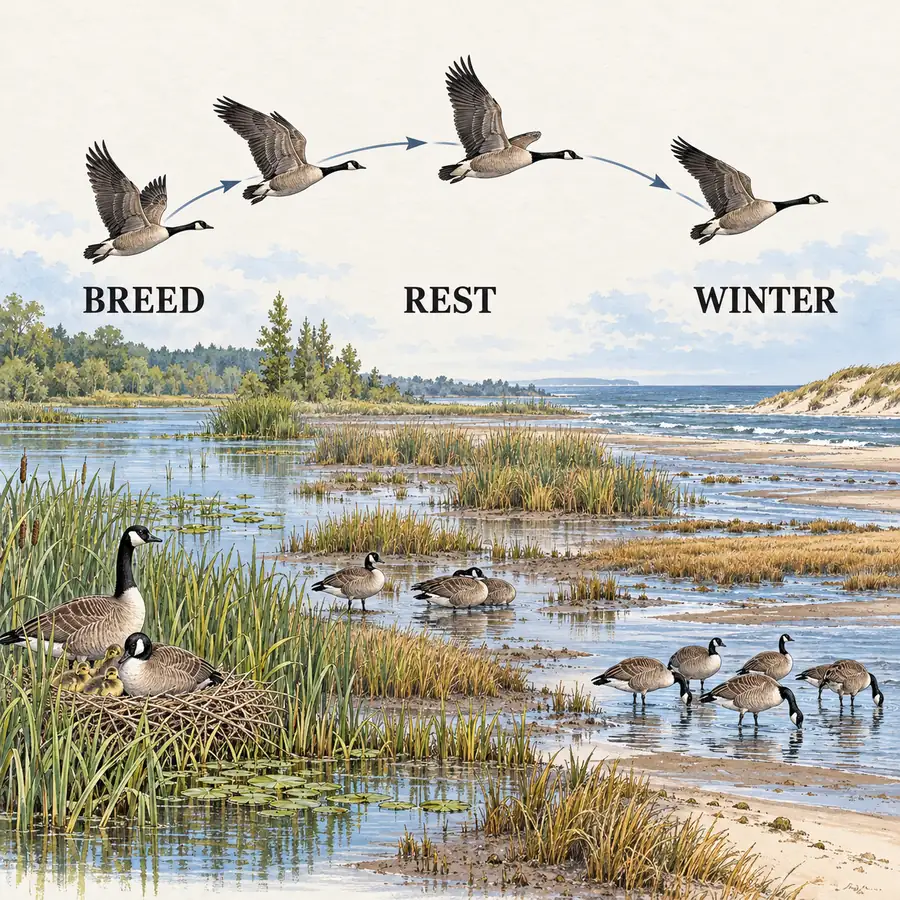
An animal migration route may connect a breeding area, one or more stopovers, and a seasonal feeding or wintering range. Losing a small resting site can matter even when the endpoint remains intact. This is why a route map should show connections as well as destinations.
16. Stopovers are working habitat
A stopover may provide food, shelter, water, or a chance to rest before the next leg. The needs differ by animal: a wetland can be crucial for one bird while a river corridor serves another species. A place is not a stopover simply because an animal was photographed there once.
17. Animals can use more than one navigation cue
Research on different species examines cues such as the sun, stars, landmarks, smell, and Earth's magnetic field. No single cue explains every migration. A careful description names the species and evidence instead of claiming that all migrating animals rely on one built-in compass.
18. Routes are affected by conditions and barriers
Weather, currents, fires, roads, fences, habitat loss, and human activity can make a familiar route harder to use. A population may change its timing or stopover choices. These effects depend on the location and species, so explain the specific barrier rather than predicting the same result everywhere.
How to verify an animal migration claim
Before using a migration fact in a classroom project, caption, or wildlife guide, check what the source actually measured. A short checklist can prevent a route for one population from being generalized to an entire species.
- 1
Name the species and population
Check whether the claim describes one species, a regional population, or an individual animal. These are not interchangeable.
- 2
Confirm the time period
Look for the season, year, life stage, and observation dates. Migration schedules can vary with conditions.
- 3
Check both ends and the route
Identify the source area, destination, and any stopovers. A single sighting does not establish a complete route.
- 4
Separate migration from other movement
Ask whether the movement repeats, follows a seasonal resource pattern, or instead describes dispersal or daily foraging.
- 5
Prefer trackable evidence
Use a government wildlife agency, research institution, tagged-animal study, or clearly dated field record for route claims.
A simple animal migration activity
For a classroom comparison, choose one migratory species and make a three-stop map: where it breeds, where it pauses, and where it spends another season. Add one resource at each stop, such as food, water, or shelter. Keep the map at the scale supported by the source rather than drawing an exact line from a broad regional summary.
Then compare a second animal with a different life cycle. A bird, salmon, and monarch butterfly can all migrate, but they do not face the same barriers or use the same habitat. The comparison is strongest when it names what is known, what varies among populations, and what the source did not measure.
- Write the species and population beside the map.
- Label each stop with a resource or life-cycle need.
- Use arrows to show direction and note the season.
- Mark unknown route sections instead of guessing.
- Compare one limitation or barrier for each example.
Animal migration FAQ
What is animal migration?
Animal migration is a repeated or population-level movement between areas used at different times, often linked to breeding, food, water, or seasonal conditions. The distance and schedule depend on the species and population.
Why do animals migrate?
Animals may move to reach food, water, suitable temperatures, or breeding and nesting areas. Several needs can overlap, so the best explanation identifies the population, season, and resource involved.
Do all animals migrate?
No. Many animals remain in one range, move locally, disperse once, or shift irregularly with resources. Migration is only one kind of animal movement.
How do migrating animals find their way?
Different species can use different cues, including landmarks, the sun, stars, smell, or Earth's magnetic field. Scientists study those cues in particular animals; there is no single navigation method used by every migrant.
What is the Great Migration in Africa?
It commonly refers to large wildebeest herds moving through parts of the Serengeti and Maasai Mara region. Rainfall and grazing affect movement, and routes or timing can vary rather than following one fixed annual line.
Is migration the same as dispersal?
Not usually. Migration often describes a recurring movement between ranges, while dispersal commonly describes an individual leaving its birthplace or group to settle elsewhere. Researchers may define terms more narrowly for a specific study.