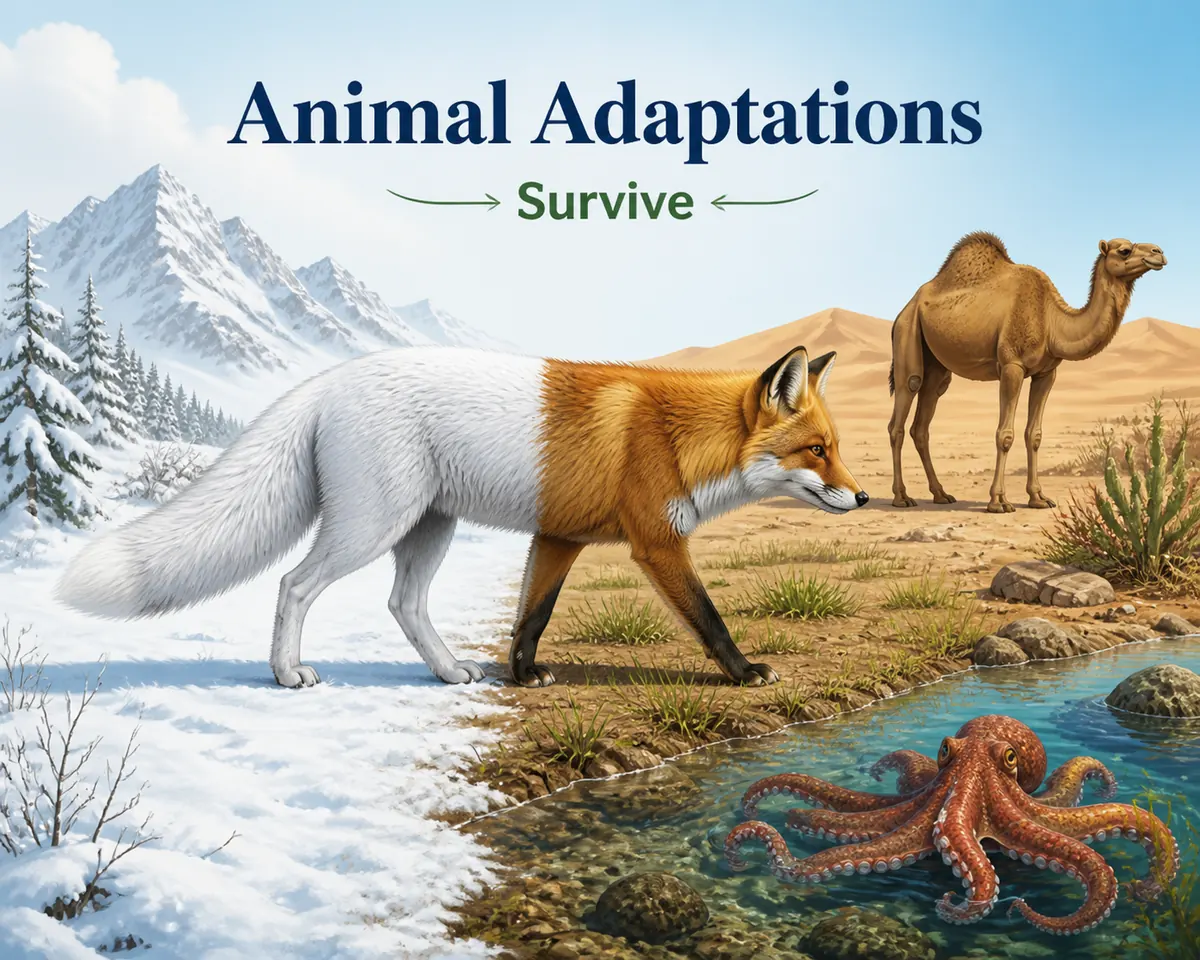
Animal adaptations solve specific survival problems
An animal adaptation is not simply a strange or impressive trait. It is a feature or behavior that improves an animal's chances of handling a recurring challenge, such as finding food, avoiding predators, staying warm, conserving water, or raising young. The connection is easiest to understand when the species and environment are named together.
For example, a camel's body helps it manage heat and scarce water, while an octopus can change color and pattern to become harder to see. Those examples are different, but both show the same reasoning pattern: identify the challenge, describe the trait, and explain the survival advantage without claiming that the animal is perfectly protected.
Animal adaptations at a glance
Use the table to match a survival challenge with a body feature, internal function, or behavior. The examples are simplified starting points; a real species profile may include several adaptations at once.
| Animal | Adaptation | Why it helps |
|---|---|---|
| Camel | Fat stored in a hump and efficient water balance | Heat and water |
| Arctic fox | Seasonal coat color and dense winter fur | Cold and camouflage |
| Polar bear | Insulating fur and a thick layer of body fat | Cold and swimming |
| Octopus | Rapid color and pattern changes | Camouflage |
| Wood frog | Protective chemicals during partial freezing | Winter survival |
| Hummingbird | Wing movement that supports hovering and reverse flight | Feeding and movement |
Three types of animal adaptations
The categories overlap in real life, but they help students and curious readers describe what they are seeing without treating every trait as the same kind of adaptation.
Structural adaptations
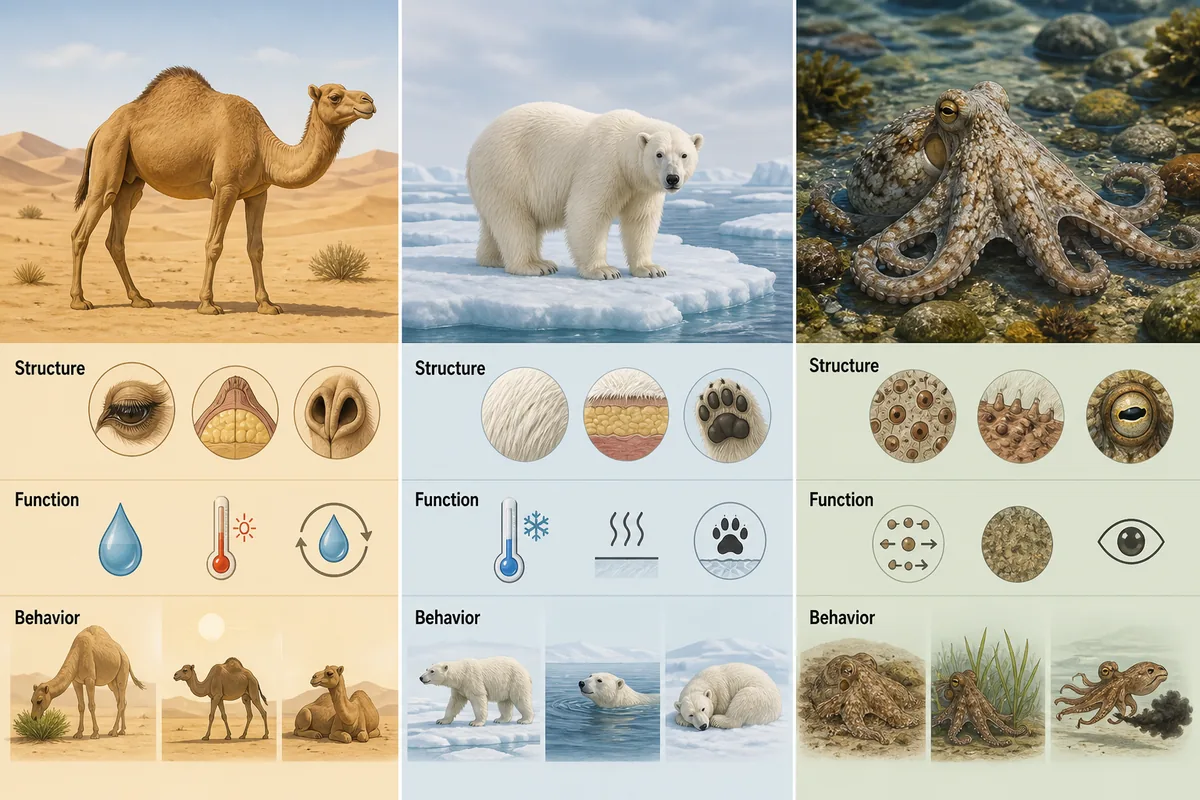
A structural adaptation is a physical feature of the body. Thick fur, webbed feet, a long beak, a shell, and the shape of a camel's nostrils are examples of structures that can affect insulation, movement, feeding, or protection. The useful question is not just what the feature looks like, but what repeated problem it helps the animal handle.
Physiological adaptations
A physiological adaptation is an internal process that helps the body function. Some animals can concentrate urine, produce protective chemicals, regulate body temperature, or alter blood flow in ways that support life in a demanding environment. These changes are less visible than a shell or stripe, so a reliable source matters when explaining them.
Behavioral adaptations
A behavioral adaptation is an action or pattern of action that improves survival or reproduction. Migration, nocturnal activity, group hunting, tool use, and choosing a sheltered nesting place can all fit this category. Behavior is often flexible, and one observed action does not prove that every member of a species behaves the same way.
Camouflage and warning signals
Camouflage can make an animal harder to detect, while warning colors or displays can make danger easier for a predator to recognize. The effect depends on the animal's background, predator, life stage, and behavior. A bright pattern is not automatically a warning signal, and camouflage is not the same as invisibility.
One animal can use several types
A polar bear combines structure and physiology through fur, body fat, and heat management, then adds behavior by choosing sea ice and water routes. When an article lists one animal adaptation, it is usually highlighting one mechanism rather than describing the whole species. Keeping that boundary makes the explanation more accurate.
Animal adaptation examples by environment
Environment-based examples make the idea concrete. They also show why the same trait can be useful in one setting but less useful in another.
Camel
A camel's hump stores fat, not a tank of water. The stored energy can be used when food is scarce, while the camel's body also limits water loss and tolerates large changes in body temperature. This combination helps it travel through hot, dry areas, but it does not make the animal independent of food and water forever.
Arctic fox
The Arctic fox grows a dense winter coat that can appear white and a thinner summer coat that is often brown or gray. Seasonal color can reduce visual contrast against snow or exposed ground. Coat color varies by population and season, so it is better to say the change supports camouflage than to call the fox invisible.
Polar bear
Polar bears have dense fur and substantial body fat that reduce heat loss in cold air and water. Their broad paws also help with walking on sea ice and swimming. These features support life in an Arctic environment, but hunting conditions, sea-ice access, and food availability still affect individual survival.
Octopus
Many octopuses can change skin color, pattern, and sometimes texture. Those changes can help them blend into a rocky seafloor, approach prey, or signal during an interaction. The exact ability differs among species, and camouflage works only when the animal can match the visual conditions around it.
Fennec fox
The fennec fox's large ears help release heat and also help it detect sounds in open desert ground. Its activity pattern, fur, and feet work together with the ears. A single body feature rarely explains all of an animal's success, so describe the ear as one part of a broader desert-living package.
Five more animal adaptations to remember
These examples cover movement, freezing, parenting, tools, and seasonal travel. They are useful for a classroom question, a drawing prompt, or a quick comparison with the animal randomizer.
Hummingbird
A hummingbird's shoulder joints and rapid wing strokes allow it to hover while feeding. Some hummingbirds can also move backward for short distances. The important point is not a simple speed record; it is that wing structure and muscle control support access to flowers that other birds may not reach in the same way.
Wood frog
The wood frog can survive partial freezing during winter. Ice forms in some spaces outside cells while protective compounds help limit cellular damage. This is a specialized seasonal survival strategy, not proof that the frog can survive any temperature or remain frozen indefinitely.
Kangaroo rat
Kangaroo rats are adapted to dry environments through behavior and water-efficient physiology. They obtain much of their water from seeds and can produce concentrated urine, while spending more time in cool burrows reduces heat and water loss. The exact balance depends on species and local conditions.
Sea otter
Some sea otters use stones as tools to open hard-shelled prey. Tool use changes the practical options available to the animal and can be learned or repeated within a population. It is a behavioral example, while the otter's dense fur is a structural feature that helps with insulation.
Monarch butterfly
Monarch butterflies migrate over long distances, and their route depends on seasonal conditions, generations, and available plants. Migration is a behavioral adaptation connected to temperature and food, but it is not a single uninterrupted journey by one individual. Wording the life cycle carefully prevents a common oversimplification.
How to verify an animal adaptation
Adaptation explanations often become inaccurate when a species-specific observation is turned into a rule for every animal. Use these checks before putting a claim on a worksheet, quiz, article, or drawing prompt.
- 1
Name the species
A precise species or group is stronger than a broad label such as all desert animals.
- 2
Identify the challenge
State whether the trait relates to heat, cold, water, food, movement, predators, or reproduction.
- 3
Separate adaptation from acclimation
A population-level inherited trait is different from a temporary change within one animal's lifetime.
- 4
Check the measurement
Words such as often, may, up to, and some species are part of accurate science writing when variation exists.
- 5
Use a specialist source
Museums, zoos, universities, conservation agencies, and primary research summaries are useful starting points.
Turn animal adaptations into a better activity
For kids or a classroom, ask learners to connect one animal to a problem: How does it stay warm? How does it find food? How does it avoid being seen? Then ask whether the answer is a body structure, an internal function, a behavior, or a combination. This makes the exercise about reasoning rather than memorizing a list.
For drawing or writing, use the same structure as a prompt: choose an animal, name its habitat, show one adaptation, and explain what would change if the habitat changed. The Random Animal Generator can supply a starting species, but the final fact should be checked against a reliable profile before it is presented as science.
- Use the quick table for a warm-up question.
- Ask students to sort traits into structure, function, and behavior.
- Compare two animals that face the same climate in different ways.
- Turn one adaptation into a labeled drawing or story constraint.
- Keep the species and the evidence attached to every surprising claim.
Animal adaptations FAQ
What is an animal adaptation?
An animal adaptation is an inherited body feature, internal process, or behavior that helps a species live and reproduce in a particular environment. A good explanation names the species, the challenge, and the way the trait helps.
What are the three types of animal adaptations?
The common categories are structural adaptations, physiological adaptations, and behavioral adaptations. Real animals often combine all three, so the categories are a helpful way to describe a mechanism rather than strict boxes.
Is camouflage an animal adaptation?
Camouflage can be a structural or behavioral adaptation when it reduces detection in a particular setting. It is not the same as invisibility, and its effectiveness depends on the background, predator, lighting, and the animal's movement.
What is the difference between adaptation and acclimation?
Adaptation usually describes inherited differences that become common in a population over generations. Acclimation is a change made by an individual during its lifetime in response to conditions, so the terms should not be used as synonyms.
How can I teach animal adaptations to kids?
Choose one familiar animal, name the environmental challenge, and ask learners to match the solution to structure, function, or behavior. Use a short source-backed example and keep caveats such as some species or may when they matter.