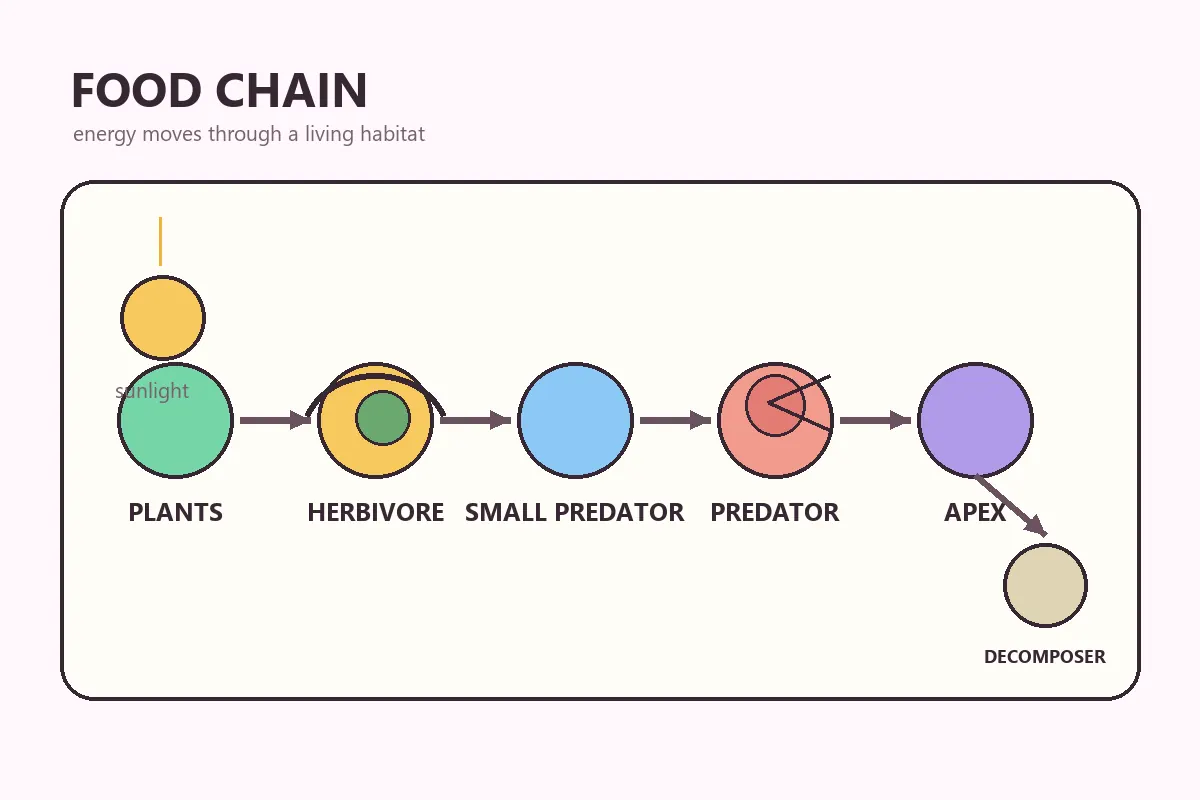
A food chain is an energy path, not a ranking of animals
In an animal food chain, each arrow means energy and matter move from a food source to the organism that eats it. A meadow example might be grass → grasshopper → frog → snake → hawk. The arrow does not mean the hawk is morally or universally better than the grasshopper; it only records the direction of feeding and energy transfer.
Most animals belong to more than one chain. A frog may eat flies and spiders, while a snake may eat frogs, mice, or birds. Those connected paths form a food web. Using the chain as a simple model and the web as the realistic model makes it easier to explain what happens when a predator disappears, a plant declines, or a new species enters a habitat.
Animal food chain roles at a glance
Use the table to label a chain before adding species. The same animal can occupy different roles in different chains, especially when it is an omnivore.
| Role | What it does | Example |
|---|---|---|
| Sunlight | Provides the starting energy for photosynthesis | Energy source |
| Producer | Makes food from light, water, and carbon dioxide | Grass or algae |
| Primary consumer | Eats a producer | Grasshopper or rabbit |
| Secondary consumer | Eats a primary consumer | Frog or small fish |
| Apex predator | Has few natural predators in that chain | Hawk or orca |
| Scavenger | Feeds on an animal that has died | Vulture or crab |
| Decomposer | Breaks down dead material and waste | Fungi or bacteria |
Seven parts of an animal food chain
The labels below are a practical way to build a diagram. They overlap in real ecosystems, so use them to describe a feeding relationship rather than to assign a permanent status to every species.
1. Sunlight starts most land chains
Green plants, algae, and some bacteria capture light energy through photosynthesis. That energy becomes chemical energy stored in food. A cave or deep-sea ecosystem may use a different starting source, but a classroom animal food chain usually begins with the sun because plants support the first consumer.
2. Producers make the first usable food
A producer makes organic food instead of obtaining all of its energy by eating another organism. Grass, leaves, kelp, and microscopic algae are common examples. Producers are not necessarily large or attractive; a thin layer of algae can support fish, insects, and many organisms that are hard to see.
3. Primary consumers eat producers
Herbivores such as rabbits, deer, caterpillars, and zooplankton feed directly on plants or algae. They move energy into the animal part of the chain. Calling an animal a primary consumer describes the relationship in that example, not everything it eats throughout its life.
4. Secondary consumers eat other consumers
A frog that eats a grasshopper is a secondary consumer in that meadow chain. Small fish, spiders, and insect-eating birds can fill the same role. The label changes when the diet changes, which is why a species can appear at more than one trophic level.
5. Tertiary consumers feed higher in the chain
A snake that eats a frog, or a heron that eats a fish that ate smaller fish, may be a tertiary consumer in a simplified diagram. Each step usually transfers less usable energy than the step below it because organisms spend energy moving, growing, and staying alive.
6. Apex predators are relative, not absolute
An apex predator has few or no regular predators within a particular chain or habitat. A hawk can be near the top of a meadow chain, while an orca can be near the top of a marine web. Human activity, disease, and changing habitat can still affect an apex predator.
7. Scavengers and decomposers close the loop
Vultures, crabs, beetles, fungi, and bacteria use dead material or waste. Scavengers often consume larger remains, while decomposers chemically break material down so nutrients can return to soil or water. They are not an optional footnote: without them, nutrients would remain locked in dead matter.
Animal food chain examples from four habitats
A chain becomes easier to remember when every arrow is tied to a place and a real feeding relationship. These examples are simplified teaching models, not complete inventories of each habitat.
Meadow: grass → grasshopper → frog → snake → hawk
The meadow chain begins with a producer that turns sunlight into plant tissue. A grasshopper transfers some of that energy to a frog, then a snake and hawk feed higher in the sequence. In a real meadow, frogs also eat spiders, hawks may eat mice, and the same grass supports many paths.
Pond: algae → insect larva → small fish → heron
Algae and aquatic plants support larvae and tiny grazers. Small fish eat some of those animals, and a heron can capture fish in shallow water. Nutrients from droppings and decomposing organisms return to the pond, where they can support another round of plant growth.
Ocean: phytoplankton → krill → fish → seal → orca
Microscopic phytoplankton are producers at the base of many ocean chains. Krill and other zooplankton consume them, fish consume the small animals, and seals can become prey for orcas. Ocean chains vary by depth, temperature, season, and species, so one diagram cannot represent every marine food web.
Forest: oak leaves → caterpillar → songbird → hawk
Leaves feed caterpillars, which can be eaten by songbirds. A hawk may prey on the bird, but it may also hunt rodents, snakes, or insects. Fallen leaves create a second pathway: fungi, bacteria, worms, and other decomposers process dead material and make nutrients available to plants.
Arctic coast: algae → small crustacean → fish → seal → polar bear
Cold-water algae can support small crustaceans and fish near the coast. Seals feed on fish, and polar bears may hunt seals where sea ice and access allow. The example highlights why habitat conditions matter: a food chain can change when ice, temperature, or prey availability changes.
Detritus chain: dead leaves → fungi → beetle → bird
Not every chain starts with a living leaf being eaten. A detritus chain starts with dead organic matter. Fungi and bacteria make the material easier to use, small animals feed on the decomposing matter, and birds or mammals eat those consumers. This is one reason a food web is more accurate than a single straight line.
Food chain vs food web: what is the difference?
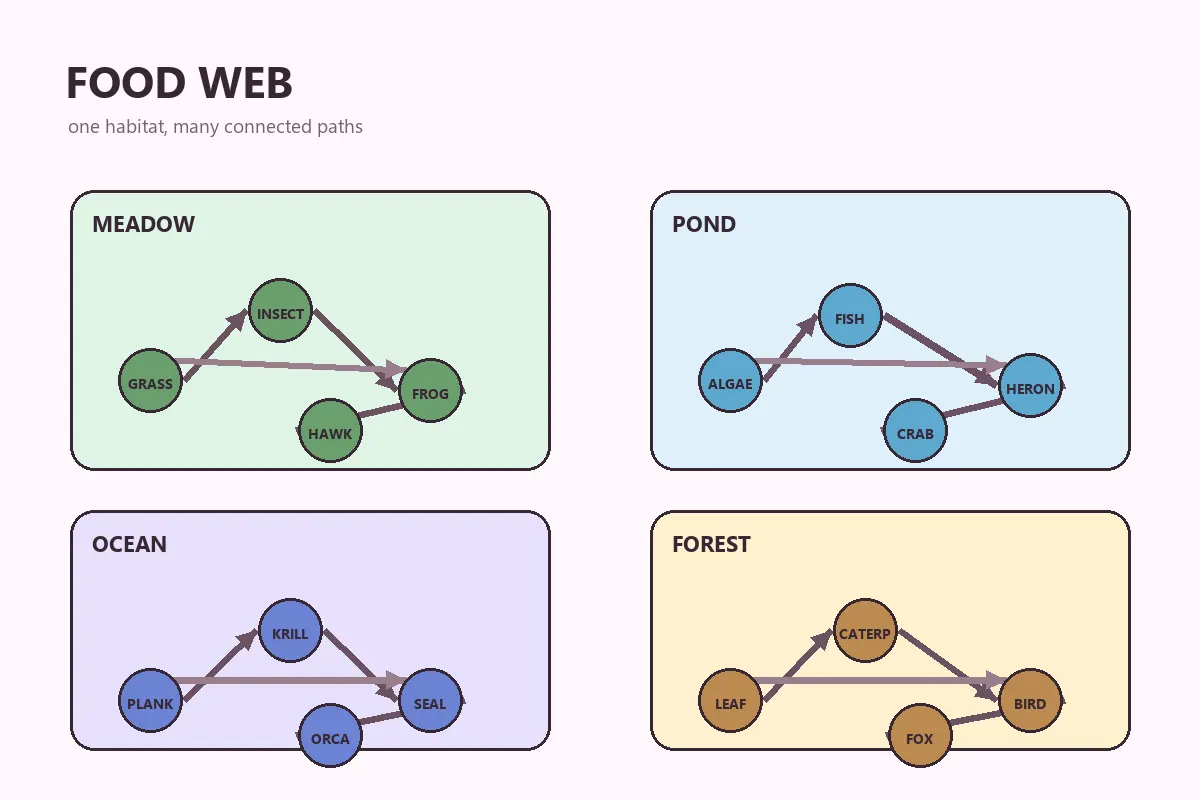
A food chain is a short path that makes one relationship visible. A food web connects many paths and shows what usually happens in a functioning ecosystem when diets overlap.
A chain uses one path
The arrow in grass → grasshopper → frog answers one narrow question: where can energy move in this example? A chain is useful for introducing producers, consumers, and trophic levels because the reader can follow the sequence without sorting dozens of links.
A web shows shared resources
In a web, grass can feed rabbits, grasshoppers, and seed-eating birds. Those animals can be eaten by several predators. The web exposes hidden connections and helps explain why a change in one population can affect species that do not directly eat one another.
Omnivores cross levels
A bear, crow, fox, or human may eat plants and animals. That species does not fit one permanent box. In a diagram, place it on the path being discussed and state what it is eating. This small clarification prevents many misleading food-chain rankings.
Energy decreases at each transfer
Organisms use much of the energy they take in for movement, body maintenance, growth, and heat. Less energy is available to the next consumer, so food chains usually have fewer high-level predators than producers. The exact amount is not a universal fixed percentage.
Removing one species can have ripple effects
If a predator disappears, prey numbers may rise and plants may decline. If a producer is lost, every consumer that depends on it faces pressure. The outcome depends on alternative foods, migration, season, and human intervention, so avoid promising one identical result for every ecosystem.
A diagram is a model, not the whole ecosystem
Use arrows, labels, and a named habitat to make a chain testable. Then add a note about missing links, decomposers, and seasonal changes. A simple model is valuable when it makes a relationship clear and states what it leaves out.
How to verify an animal food chain
Food-chain diagrams can look convincing even when a species, arrow, or habitat is wrong. Use these checks before reusing one in a lesson, quiz, article, or drawing prompt.
- 1
Name the habitat
Write meadow, pond, forest, ocean, or another specific setting so the relationships have context.
- 2
Check every arrow
Read each arrow as 'is eaten by' or 'energy moves to' and confirm that the prey is actually part of the predator's diet.
- 3
Separate a model from a rule
Say simplified example or one possible chain when the species has a broader diet.
- 4
Include decomposers
Mention fungi, bacteria, and detritus when the goal is to explain nutrient cycling rather than only predator order.
- 5
Use a specialist source
Museums, universities, conservation agencies, and government science pages can verify diet, habitat, and seasonal limits.
Turn a food chain into a better activity
For a classroom or family activity, choose one habitat and ask learners to place a producer, two consumers, a predator, and a decomposer in order. Then remove one card and ask what other food or predator could change the result. The exercise teaches systems thinking without pretending that a real ecosystem is a fixed row of animals.
For writing and drawing, use the Random Animal Generator to choose a species, then give it a habitat and one plausible food relationship. The generated animal is an idea starter, not evidence. Check the real species profile before calling a diet or predator relationship factual.
- Draw arrows only after naming what each organism eats.
- Compare a short food chain with the larger food web around it.
- Add a decomposer card to show nutrient cycling.
- Ask what changes if a producer, prey species, or predator declines.
- Label a simplified model so readers know what it leaves out.
Animal food chain FAQ
What is an animal food chain?
An animal food chain is a simplified path that shows how energy and matter move from a producer to consumers and, eventually, decomposers. The arrows represent feeding or energy transfer, not a permanent ranking of species.
What animal is at the top of the food chain?
There is no single top animal for every ecosystem. An orca, polar bear, lion, or hawk may be near the top of a particular local food web, but the answer depends on habitat, prey, predators, and human influence.
What is the difference between a food chain and a food web?
A food chain follows one feeding path, while a food web connects many overlapping paths. Food webs are usually a better model for real ecosystems because animals often eat more than one kind of food.
Where do decomposers fit in a food chain?
Fungi, bacteria, and other decomposers break down dead material and waste. They return nutrients to soil or water, so they connect the end of a feeding path back to producers even when they are not drawn in a straight line.
Can an animal be on more than one trophic level?
Yes. An omnivore can eat plants and animals, and a predator can change its diet by season or life stage. Give the animal's role for the specific chain you are drawing instead of treating one label as permanent.
What happens if one animal in a food chain disappears?
The effect depends on alternative foods, predators, season, and habitat. Prey may increase, plants may decline, or another species may fill part of the role. A food web helps explain why the result is rarely a single predictable step.