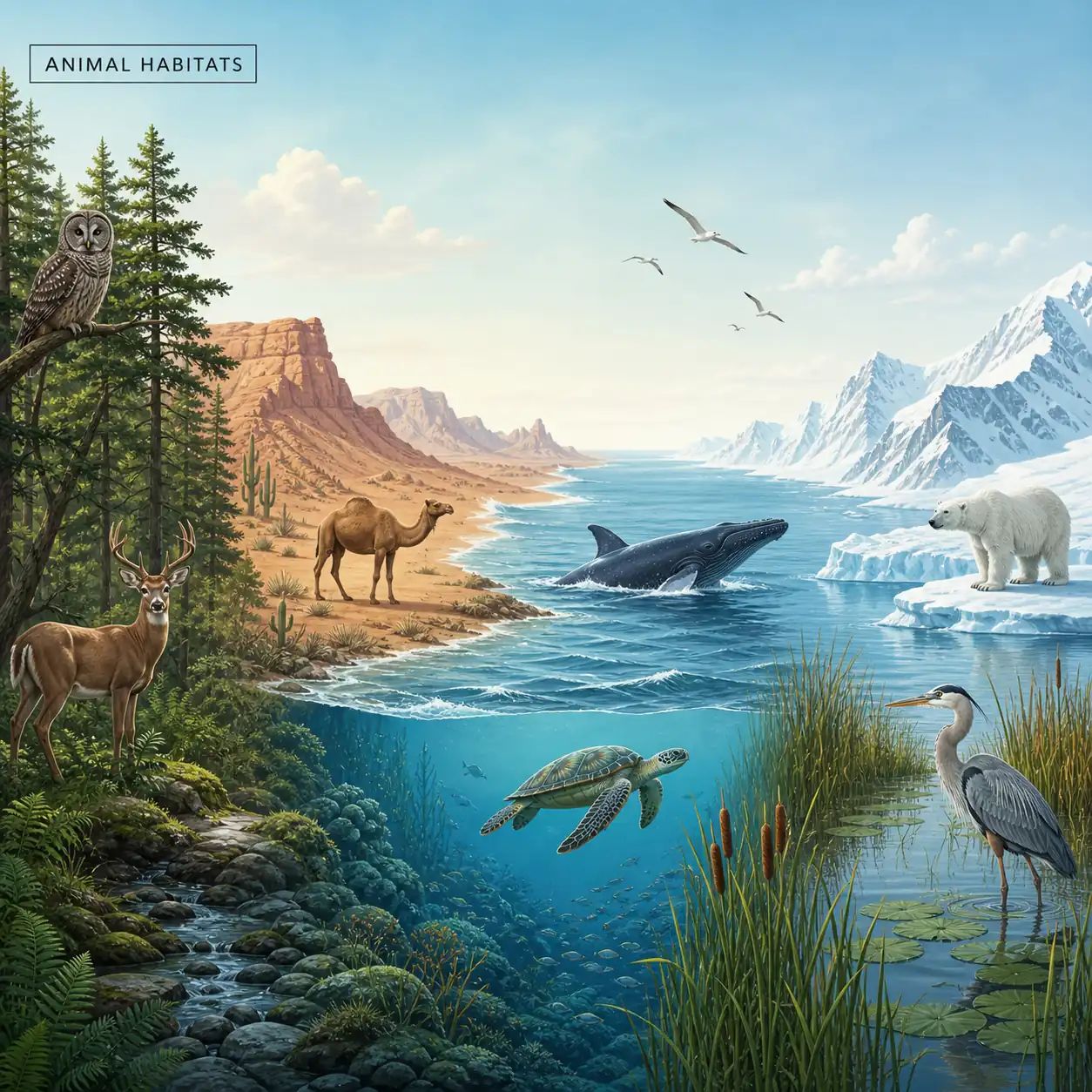
A habitat is an animal's workable home
A habitat is more than a location on a map. It is the living space and physical setting where an animal can obtain resources, avoid danger, find members of its species, and complete its life cycle. A pond, for example, includes water conditions, plants, mud, oxygen, hiding places, and seasonal changes—not just a blue shape on a diagram.
The same animal may use several habitats during a day or across its life. A frog can feed at the edge of a wetland, shelter in vegetation, and lay eggs in shallow water. Thinking in terms of needs makes animal habitats easier to compare and prevents the common mistake of treating one photograph or one region as the whole story.
Animal habitats at a glance
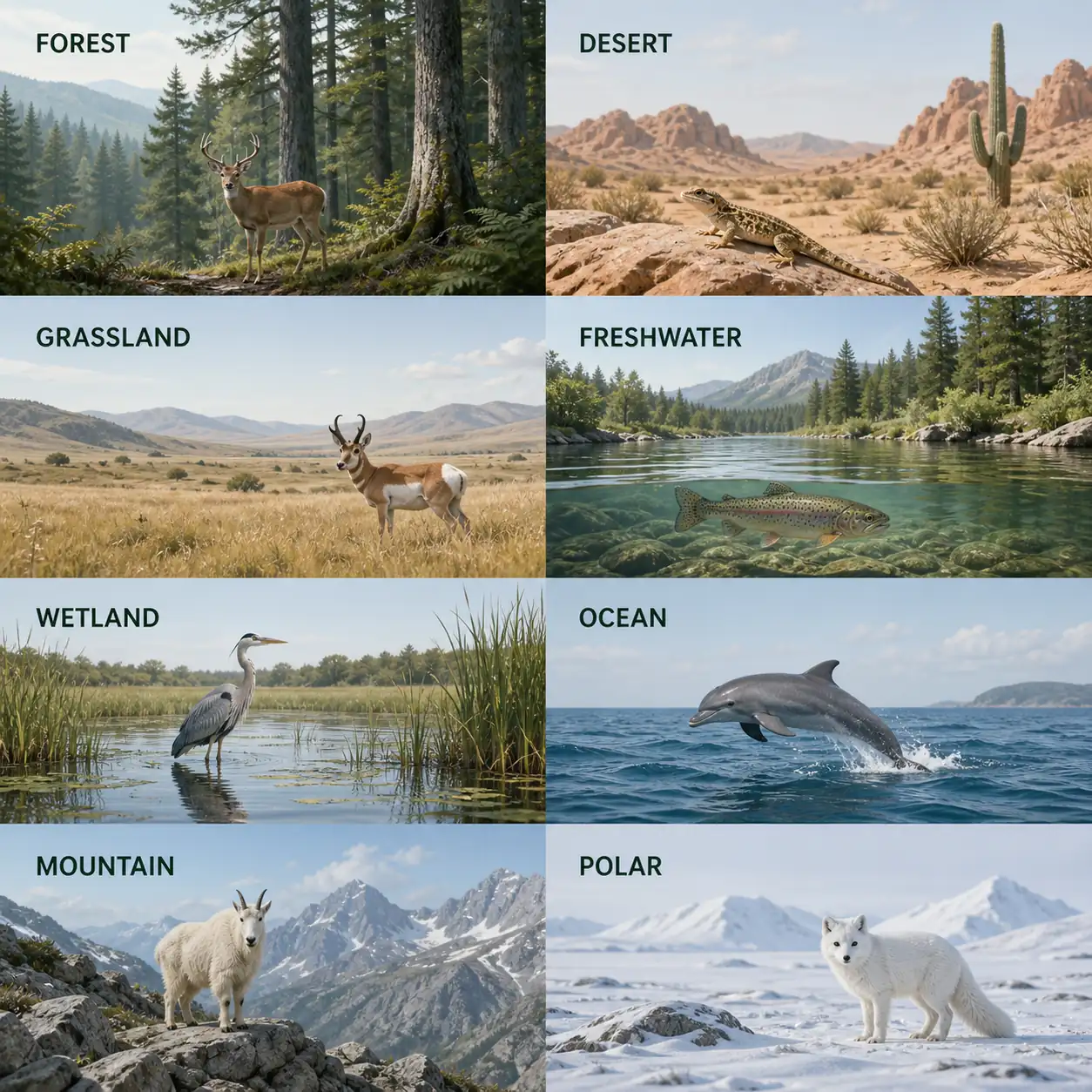
Use this table to connect each environment with the conditions it offers and a few animals that may use it. These are broad examples, not rules that apply to every species in every location.
| Habitat | Typical conditions | Animal examples |
|---|---|---|
| Forest | Layered plants, shade, and changing moisture | Owls, deer, insects |
| Desert | Little rainfall, strong temperature swings, sparse cover | Camels, fennec foxes, lizards |
| Grassland | Open space, grasses, fire or grazing cycles | Bison, zebras, prairie dogs |
| Freshwater | Low-salt water in rivers, lakes, and ponds | Frogs, trout, beavers |
| Wetland | Waterlogged soil or shallow seasonal water | Herons, dragonflies, otters |
| Ocean | Saltwater with depth, currents, and light zones | Whales, fish, sea turtles |
| Mountain | Steep elevation, thin air, and rapid weather change | Goats, eagles, pikas |
| Polar | Cold temperatures, ice or tundra, short growing seasons | Polar bears, seals, arctic foxes |
What is a habitat?
A clear definition helps separate a habitat from nearby terms that describe a larger system or a species' particular role.
A place plus the conditions
A habitat is the natural home or environment where an animal normally finds the resources and conditions it needs. Those conditions can include temperature, water, oxygen, soil, light, shelter, prey, plants, and safe places to raise young. The useful question is not only where the animal is seen, but what the place provides.
Habitat and ecosystem are not identical
An ecosystem includes living organisms and the nonliving environment, together with the interactions among them. A habitat is the place and conditions used by a particular animal or group. A wetland ecosystem can contain many habitats, such as open water, reeds, mud, and woodland edges, each serving different species.
Habitat and niche answer different questions
A habitat asks, “Where does it live?” A niche asks, “How does it make a living there?” Two animals can share a forest habitat while eating different foods, using different shelter, or being active at different times. This distinction is useful when comparing animals and their habitats without assuming they compete for everything.
One animal can need more than one habitat
Many species move between habitats for feeding, nesting, migration, or seasonal protection. Salmon use freshwater streams for part of their life and the ocean for another part. Migratory birds may depend on breeding grounds, stopover wetlands, and wintering areas. A single local habitat may be important without being the animal's entire range.
Eight types of animal habitats
The categories below are broad teaching groups. Real landscapes overlap, and a forest can contain streams, wetlands, cliffs, and open clearings that create smaller habitats within it.
1. Forests
Forests have layers of vegetation, from leaf litter and roots to shrubs and high canopies. Light, moisture, and temperature can change sharply between those layers. Woodpeckers use tree trunks, deer browse in openings, and salamanders often depend on damp ground. Forest animals may use the same broad habitat while occupying different vertical or seasonal spaces.
2. Deserts
Deserts are defined by limited precipitation, not simply by being hot. Some are cold, and many experience large differences between daytime and nighttime temperatures. Camels, fennec foxes, kangaroo rats, snakes, and lizards use different strategies for water, heat, and shelter. Burrows, nocturnal activity, and scattered plants can be as important as the sand itself.
3. Grasslands and savannas
Grasslands are open habitats where grasses and seasonal plants dominate, while savannas usually combine grass with scattered trees or shrubs. Grazing, drought, and periodic fire can shape the vegetation. Bison, zebras, antelope, prairie dogs, and many ground-nesting birds depend on open sight lines, plant growth, or the insects supported by these cycles.
4. Freshwater rivers, lakes, and ponds
Freshwater habitats have relatively low salt levels and include flowing rivers, still lakes, temporary ponds, and small streams. Water speed, depth, oxygen, temperature, and vegetation determine which animals can use a particular site. Trout need well-oxygenated water, frogs may need shallow edges, and beavers can change a stream by building dams.
5. Wetlands
Wetlands are places where water covers or saturates the soil for at least part of the year. Marshes, swamps, bogs, and mangrove areas differ in salt, vegetation, and water movement, but all can provide nurseries, feeding areas, and flood storage. Herons, frogs, insects, fish, and otters may use different parts of the same wetland.
6. Oceans and coastal habitats
Marine habitats include shorelines, coral reefs, kelp forests, the open ocean, and deep water. Salt, pressure, currents, temperature, and available light change with depth and distance from land. Sea turtles use beaches for nesting, reef fish use complex cover, and whales travel through large areas where food may be seasonal.
7. Mountains
Mountain habitats change with elevation, slope, exposure, and snow. Higher areas are often colder, windier, and lower in oxygen, while valleys can hold forests or streams. Mountain goats can move across steep rock, pikas gather plants for winter, and eagles use updrafts. A mountain range therefore contains many connected habitats rather than one uniform zone.
8. Polar and tundra habitats
Polar environments and tundra have cold temperatures, short growing seasons, and limited tree growth. Sea ice, snow, permafrost, and seasonal daylight affect movement and food access. Seals use ice or water, arctic foxes follow changing prey, and polar bears depend on marine food webs. Conditions vary widely between sea ice, coastal tundra, and inland ground.
How animals use their habitats
The best animal habitat examples connect a place to a specific need. This makes the explanation more useful than naming an environment without describing what happens there.
Food and foraging space
A habitat can supply seeds, leaves, nectar, prey, algae, or carrion, but the food must also be reachable at the right time. A beaver needs woody plants near water, while a hummingbird needs flowers and safe perches. Seasonal food changes can make an otherwise suitable habitat useful for only part of the year.
Water, shelter, and temperature
Animals need different combinations of drinking water, moisture, shade, cover, and warmth. A desert lizard may use a rock for heat in the morning and hide from heat later. A wetland frog may need shallow water for eggs and dense plants for protection. Habitat quality depends on whether these resources occur together.
Adaptations work inside habitats
An adaptation is a trait or behavior that helps an animal handle a recurring challenge; a habitat is the setting where that challenge and solution meet. Webbed feet may help in water, but they do not define the whole habitat. Use the related animal adaptations guide when you want to examine the mechanism behind one feature.
Movement connects separate places
Paths, rivers, shorelines, and seasonal corridors let animals move between feeding, breeding, and shelter areas. A habitat can be locally suitable but difficult to reach if roads, fences, or development break the connection. Looking at movement explains why a map of isolated green patches may not represent a fully usable home.
The same habitat can support many roles
A pond may be a breeding site for frogs, a drinking place for mammals, a nursery for insects, and a feeding area for birds. These uses overlap without being identical. Asking who uses which layer, resource, or time of day is a practical way to study animals and their habitats without reducing them to a single label.
Habitat loss, fragmentation, and change
Habitat change is a broad topic. Accurate explanations name the species, location, time period, and evidence instead of treating every landscape change as the same kind of risk.
Loss is more than a smaller area
Habitat loss can mean that a place is converted, polluted, drained, cleared, or otherwise no longer provides the needed conditions. A smaller area may still be usable for one species but not another. Food quality, nesting cover, water chemistry, and human disturbance can change before the landscape looks completely different.
Fragmentation changes access
Fragmentation divides a larger habitat into separated pieces. Roads, buildings, fences, or intensive land use can make it harder to move, find mates, recolonize empty areas, or escape seasonal danger. A connected corridor may therefore be valuable even when it is not a place where an animal spends most of its time.
Climate shifts can move suitable conditions
Warming, altered rainfall, changing snow cover, ocean conditions, and extreme events can change where food or shelter is available. The response differs by species: some move, some adjust timing, and some face a smaller usable range. Avoid claiming that one climate trend affects every animal in the same way.
Check conservation claims against current sources
If a page says that an animal is threatened or losing habitat, verify the species and region with a current conservation source such as the IUCN Red List, NOAA Fisheries, a national agency, or a species profile from a zoo or museum. Categories and population estimates can change, so a timeless list may become misleading.
How to check an animal habitat claim
Habitat descriptions become clearer and more trustworthy when they show what was checked. Use this short sequence before turning a fact into a lesson, quiz, article, or drawing prompt.
- 1
Name the animal or group
A species or well-defined group is more useful than saying all animals in a continent.
- 2
Name the habitat scale
Say whether you mean a broad biome, a wetland type, a local site, or a seasonal range.
- 3
List the resource
Connect the place to food, water, shelter, temperature, breeding space, or movement.
- 4
Separate habitat from adaptation
The place is the setting; the trait or behavior is the adaptation that may help the animal use it.
- 5
Check the date and source
Use a specialist profile or conservation database for claims about range, threat status, or environmental change.
Turn animal habitats into a better activity
For kids or a classroom, choose one animal and ask three questions: Where does it live? What does that place provide? What would change if one resource disappeared? The animal habitats table gives a starting point, while the Random Animal Generator can supply a species for a compare-and-check exercise.
For drawing or writing, show the animal in a habitat rather than placing it on an empty background. Add one food source, one shelter, one environmental pressure, and one seasonal change. Then check the species profile before presenting the scene as a factual claim.
- Match an animal with its habitat and one specific resource.
- Compare two species that share a forest, pond, or grassland.
- Sort examples into terrestrial, freshwater, and marine environments.
- Draw a habitat cross-section with a surface, shelter, and food layer.
- Use a source link when a range, threat status, or climate claim matters.
Animal habitats FAQ
What is an animal habitat?
An animal habitat is the place and set of physical conditions where a species finds resources such as food, water, shelter, space, and breeding opportunities. It describes a workable home, not only a geographic name.
What are the main types of animal habitats?
Common broad groups include forests, deserts, grasslands, freshwater, wetlands, oceans and coasts, mountains, and polar or tundra habitats. These groups overlap, and one landscape can contain several smaller habitats.
What animals live in the desert?
Desert animals include camels, fennec foxes, kangaroo rats, snakes, lizards, insects, and many birds. The exact species depends on the desert, and the animals may use burrows, shade, plants, or nighttime activity to manage limited water and strong temperature changes.
How do animals adapt to their habitats?
Animals may use inherited body features, internal processes, or behaviors that help with a recurring challenge such as cold, heat, water, food, predators, or movement. Habitat is the setting; adaptation is the trait or behavior that can help an animal use that setting.
What is the difference between a habitat and an ecosystem?
A habitat is the home and conditions used by a particular animal or group. An ecosystem includes living organisms, nonliving conditions, and the interactions among them. One ecosystem can contain many habitats and many species.
What animals are losing their habitats?
Many species can be affected by conversion, fragmentation, pollution, climate shifts, or other changes, but the details depend on the species and region. Check a current source such as the IUCN Red List, NOAA Fisheries, or a national conservation agency instead of relying on a timeless list.