A six-group chart is a starting point, not the whole tree of life
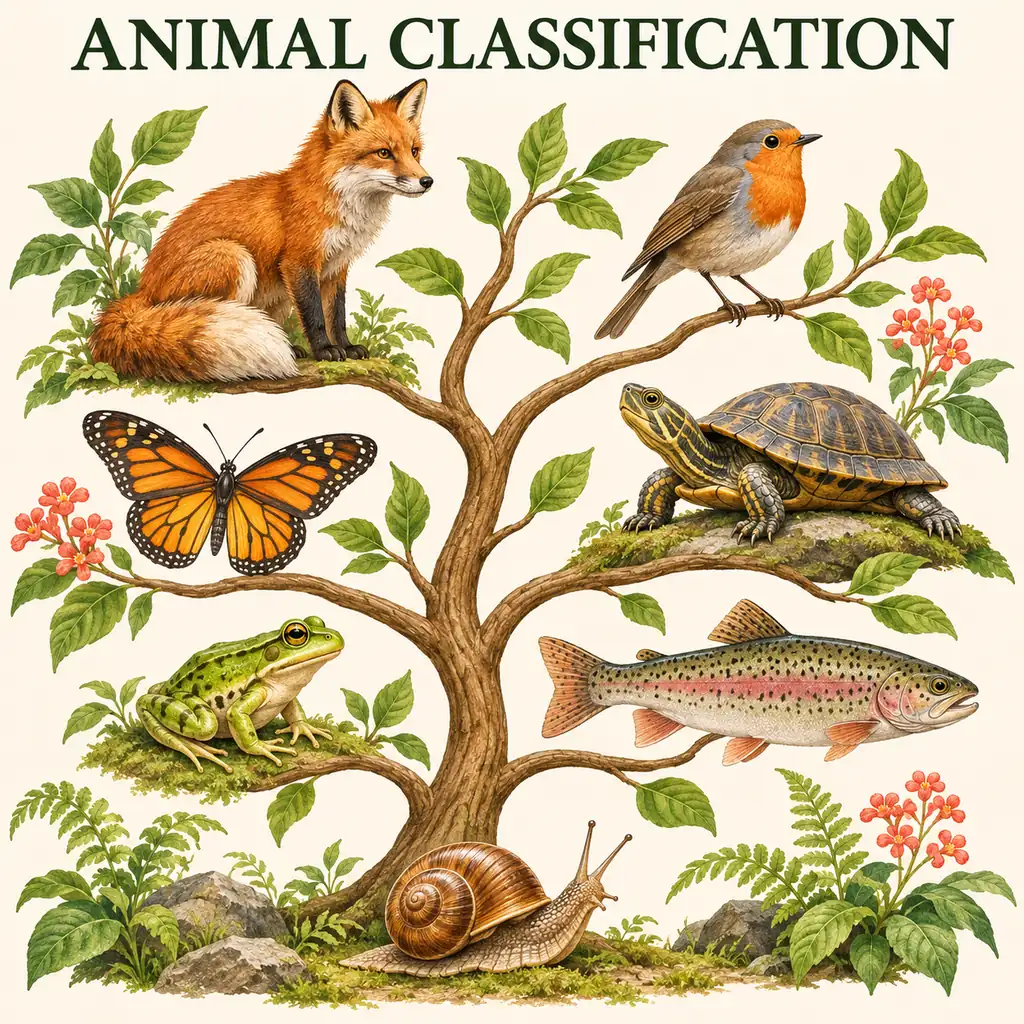
The simplest animal classification chart has five familiar vertebrate groups: mammals, birds, reptiles, amphibians, and fish. It adds invertebrates as a sixth broad group for animals without a backbone. The chart is useful for comparing visible traits, but it mixes categories at different levels: invertebrates include many phyla, while mammals and birds are much narrower groups.
Formal classification uses nested ranks such as kingdom, phylum, class, order, family, genus, and species. Each rank groups organisms within a larger one. The names and boundaries can be revised when new anatomical, fossil, or genetic evidence changes how scientists understand relationships.
Six familiar animal groups at a glance
Use the clue column to start a comparison, then check a reliable species source. A single visible feature is not always enough to identify an animal, and a common chart is simpler than formal taxonomy.
| Chart group | Useful clue and examples | Classification note |
|---|---|---|
| Mammals | Hair or fur at some life stage; females produce milk. Foxes, bats, whales, and people are mammals. | Vertebrate group |
| Birds | Feathers are the defining living-animal clue; beaks and hard-shelled eggs are also common. Robins, penguins, and ostriches are birds. | Vertebrate group |
| Reptiles | Usually have scales and develop from amniotic eggs, though many species give birth to live young. Turtles, snakes, and crocodilians are reptiles. | Vertebrate group |
| Amphibians | Many have a life stage in water and a later stage on land, with skin that can exchange water and gases. Frogs, salamanders, and caecilians are examples. | Vertebrate group |
| Fish | Aquatic vertebrates usually breathe with gills. This familiar chart word covers several lineages rather than one single modern class. | Vertebrate umbrella in school charts |
| Invertebrates | Animals without a backbone, including insects, spiders, crabs, snails, worms, corals, jellyfish, and sponges. | Broad umbrella across many phyla |
How the animal classification ladder works
A taxonomic rank is a level in a nested system. Moving down the ladder generally narrows the group, but the labels do not work like a score or a simple list of animal types.
1. Kingdom names the very broad group
Animalia is the kingdom containing animals: multicellular organisms that obtain energy by consuming or absorbing organic material and develop in ways that distinguish them from plants, fungi, and most single-celled life. The kingdom is extremely diverse, so it is only the first address in a classification, not a useful final identification for one species.
2. Phylum groups major body plans
A phylum collects animals that share a broad structural pattern and ancestry. Chordates include animals with a notochord at some stage; vertebrates are one familiar subgroup within chordates. Arthropoda is another large phylum, including insects, spiders, and crustaceans. A school chart may focus on a few phyla while leaving many out.
3. Class and order add finer detail
Classes and orders divide larger lineages into smaller sets. Mammalia is the class of mammals; Carnivora is an order that includes cats, dogs, bears, and seals. Similar appearance alone does not decide an animal's place: classification considers multiple traits and evidence about shared descent.
4. Family, genus, and species identify closer relatives
A family contains related genera, a genus groups especially close species, and a species is the basic named unit used in most introductory examples. For the red fox, Vulpes is the genus and Vulpes vulpes is the scientific name. The two-part name reduces confusion caused by different common names.
5. Classification can be updated
Scientists revise group boundaries when better fossils, anatomical comparisons, or molecular data change the evidence for relationships. A familiar name may stay the same while the accepted family or order changes. Check the date and scope of a source when exact scientific placement matters; a children’s chart is designed to teach broad patterns, not replace a taxonomic database.
Five familiar vertebrate groups
Vertebrates have a backbone and an internal skeleton. The following groups are useful in basic education, but the word “fish” is a convenient everyday category and does not represent one complete branch of modern evolutionary classification.
1. Mammals
Mammals have hair at some point in life and produce milk for their young. Many give birth to live young, but egg-laying monotremes such as the platypus show why a shortcut needs exceptions. Whales and bats are mammals despite living in water or flying; habitat and movement do not override the traits that define the group.
2. Birds
Feathers distinguish birds from every other living animal group. Their forelimbs are wings, although not every bird flies: ostriches and penguins are clear examples. Beaks, lightweight skeletons, and eggs are common bird traits, but the strongest quick identification clue is a correctly identified feather rather than the ability to fly.
3. Reptiles
Reptiles include turtles, lizards, snakes, tuatara, and crocodilians. Their skin is covered with scales or scutes, and they are amniotes, a group that protects embryos during development. Some reptiles lay eggs, while others retain eggs or give birth to live young. They are not “cold-blooded” in the sense of being unable to regulate behavior or body temperature.
4. Amphibians
Frogs, salamanders, and caecilians are amphibians. Many amphibians begin with an aquatic larval stage and undergo metamorphosis, but life cycles vary by species. Their permeable skin makes moisture and environmental conditions important. Do not classify an animal as an amphibian only because it lives near water; the species' anatomy and lineage matter.
5. Fish
Fish are aquatic vertebrates that typically use gills and fins, but there is substantial variety among jawless fish, cartilaginous fish such as sharks, and bony fish such as trout. “Fish” is helpful in a beginner chart but not a single class that contains all descendants of one exclusive ancestor. More advanced classification separates these lineages.
Invertebrates are an umbrella, not one class
An invertebrate is an animal without a vertebral column. The label gathers many unrelated-looking branches of Animalia for comparison, so a precise chart should name the smaller group whenever possible.
1. Arthropods
Arthropods have jointed appendages and an external skeleton that is shed as they grow. Insects, spiders, centipedes, crabs, and shrimp all belong to this phylum, but they are not the same class. A beetle has six legs as an adult; spiders have eight. These visible clues can narrow a classification before a species is known.
2. Mollusks
Mollusks include snails, clams, mussels, octopuses, and squids. Many have a mantle and a muscular foot, although those structures can look very different in a fast-moving squid and a shelled snail. A shell is common but not universal, so “has a shell” is not a reliable rule for every mollusk.
3. Annelids and other worms
Segmented annelids include earthworms and leeches. Other worm-shaped animals belong to different phyla, which is why “worm” describes a body form rather than one taxonomic group. An earthworm's repeated body segments and internal structure provide better clues than its long, soft appearance alone.
4. Cnidarians
Jellyfish, sea anemones, and corals are cnidarians. They have specialized stinging cells used to capture prey or defend themselves. A jellyfish's drifting body and a coral colony look unlike a backbone-bearing animal, yet both belong to Animalia and share the defining cnidarian cell type.
5. Echinoderms and sponges
Sea stars, sea urchins, and sea cucumbers are echinoderms, a marine group with a distinctive body plan and water vascular system. Sponges are simpler animals that filter water through pores. These examples show why one “invertebrate class” would be inaccurate: the umbrella contains many body plans and deep evolutionary branches.
How to classify an unfamiliar animal step by step
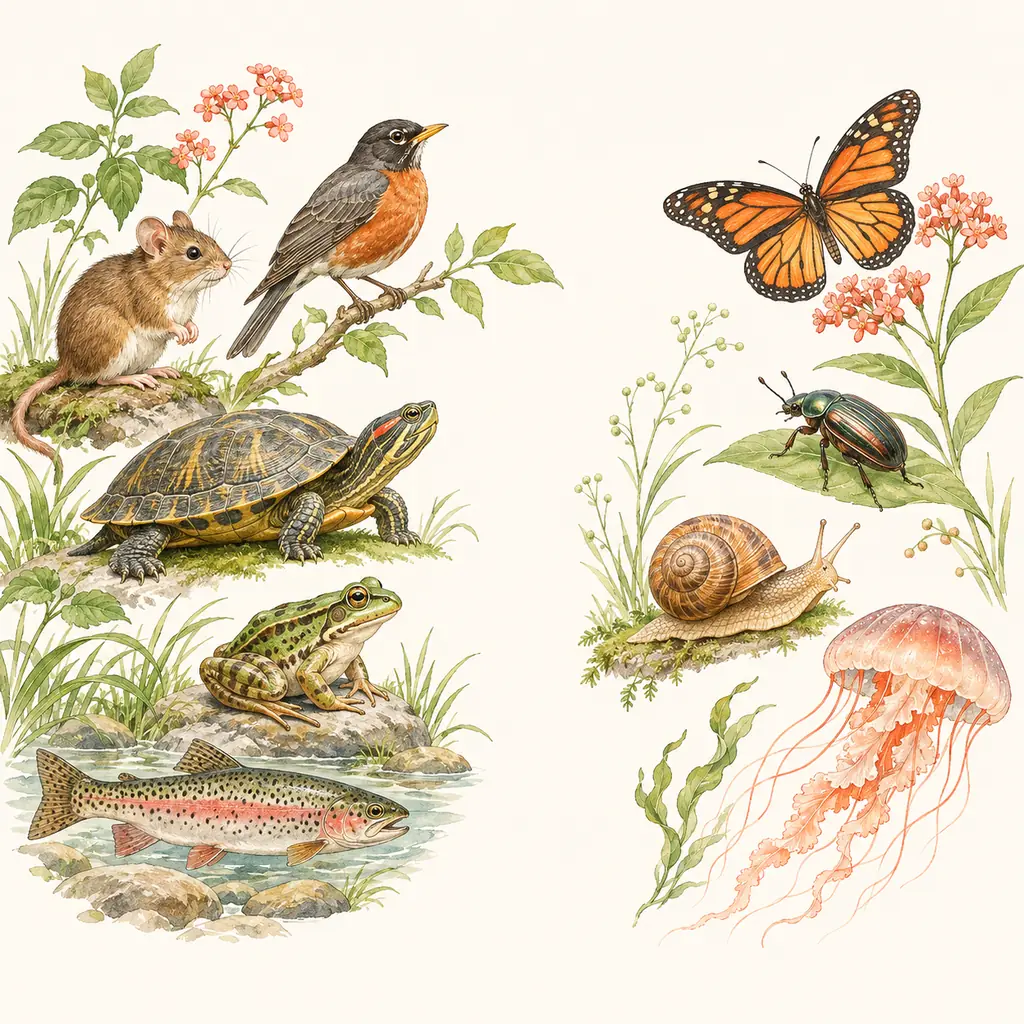
A good classification starts with observable traits and a trustworthy reference. It does not rely on habitat, one unusual behavior, or a guess based on a familiar common name.
- 1
Record the species or the best available animal group
A precise species name is ideal. If you do not know it, describe the animal and keep the answer provisional instead of attaching a scientific label too early.
- 2
Check for a backbone
A backbone points to a vertebrate. Its absence points to the broad invertebrate umbrella, after which you can look for features such as jointed legs, a shell, or stinging cells.
- 3
Compare several traits
Look at body covering, limbs, breathing structures, development, and anatomy together. Feathers identify birds more reliably than flight; gills alone do not make every aquatic animal a fish.
- 4
Separate the habitat from the classification
A dolphin lives in the ocean but is a mammal; a bat flies but is also a mammal. Habitat and movement explain how an animal lives, not which taxonomic group it belongs to.
- 5
Verify the scientific name and source date
Use a museum, university, species database, or current field guide. Record the source and date when you need a citation, and check whether it describes a school-level category or a formal taxonomic rank.
Turn classification into a useful learning activity
For a classroom comparison, choose one animal from two different groups and ask which observation supports each placement. Learners can then add a counterexample, such as a flightless bird or a live-bearing reptile, to see why a single rule rarely works for every species.
For a drawing or writing prompt, start with a known animal and keep its group separate from its habitat and behavior. A random animal can provide a subject, while the final classification should come from a reliable source rather than a generated creative result.
- Ask what evidence distinguishes the two animals.
- Label each example as a broad chart group or a formal rank.
- Add one exception that tests the shortcut.
- Link the species name to a trustworthy reference.
- Keep habitat, adaptation, and taxonomy as separate ideas.
Animal classification FAQ
What groups are animals divided into?
A common introductory chart shows mammals, birds, reptiles, amphibians, fish, and invertebrates. It is a teaching shortcut, not six equivalent formal taxonomic groups: invertebrates include many phyla, and “fish” groups several lineages.
What is the difference between vertebrates and invertebrates?
Vertebrates have a backbone; invertebrates do not. Invertebrates include arthropods, mollusks, annelids, cnidarians, echinoderms, and many more groups, so the word is a broad umbrella rather than a single class.
Are insects animals?
Yes. Insects are animals in the kingdom Animalia and are arthropods. Their jointed legs and external skeleton distinguish them from other invertebrates; adult insects have six legs, although their larval forms can look quite different.
Is fish a taxonomic class?
Not as one complete modern evolutionary group. “Fish” is useful in everyday and school charts, but jawless fish, sharks, and bony fish belong to different lineages. A detailed classification names the specific group instead of treating all fish as one class.
Why do animal classifications change?
New fossils, anatomical comparisons, and genetic evidence can reveal that groups are related differently than scientists once thought. A broad classroom chart may stay useful, while formal scientific names or boundaries are updated as evidence improves.