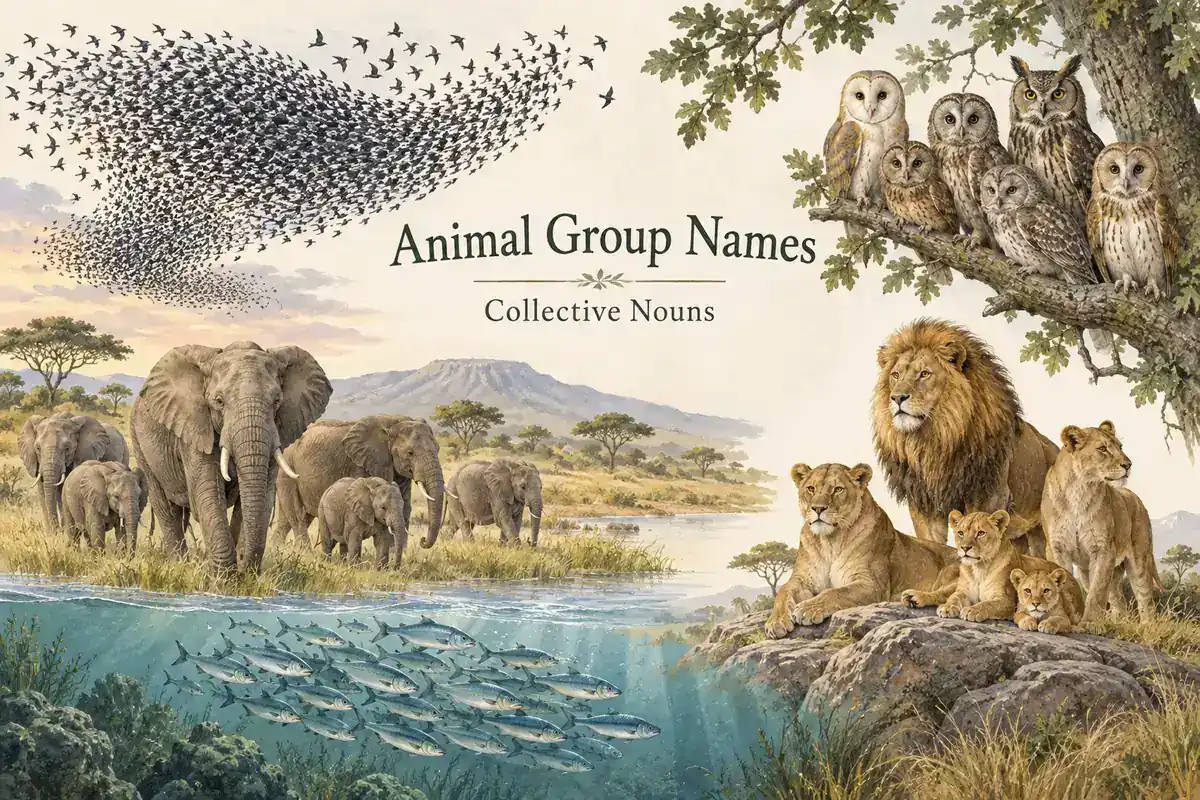
A group name is a useful shortcut, not a rule every animal must follow
A collective noun is a word or phrase that treats several individuals as one group. Animal group names often make a sentence vivid: a pack of wolves suggests coordinated movement, while a school of fish suggests a coordinated formation. These terms describe language and observation; they do not change the animals' biology.
The table below focuses on widely recognized names and flags unusual ones. You will also find an A–Z-style reference, sentence patterns, and a method for checking a term before using it in schoolwork, a quiz, or a nature caption. When sources disagree, prefer the common term and explain the context.
20 familiar animal group names
These are practical starting points rather than a complete dictionary. Several animals have more than one group name, and some colorful terms are mainly used in books, quizzes, or traditional hunting vocabulary.
| Animal | Common group name | Example sentence |
|---|---|---|
| Antelope | herd | A herd of antelope crossed the open grassland. |
| Bats | colony | A colony of bats roosted in the old bridge. |
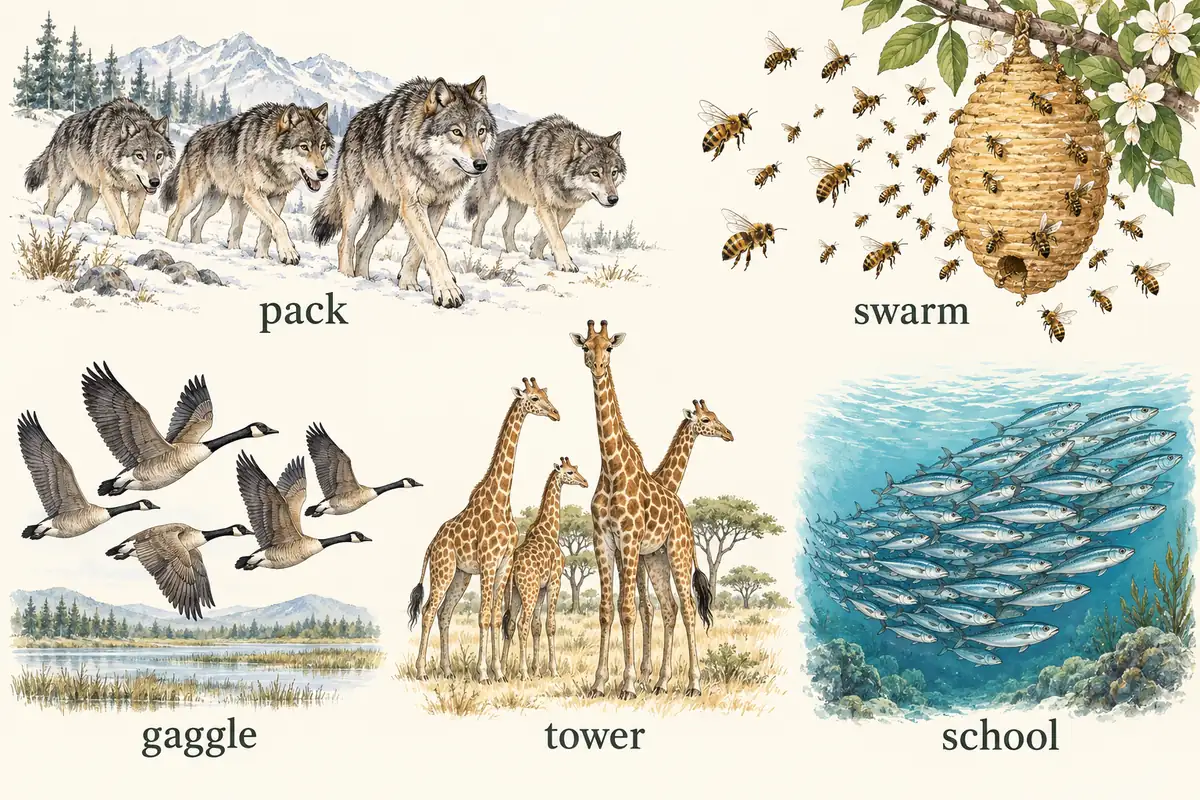
| Bees | swarm | A swarm of bees gathered around the hive. |
| Birds | flock | A flock of birds lifted from the reeds. |
| Crows | murder | A murder of crows called from the field; this is a traditional term. |
| Dogs and wolves | pack | The pack moved together along the forest edge. |
| Dolphins | pod | A pod of dolphins surfaced beside the boat. |
| Elephants | herd | The herd of elephants stayed close to the youngest calf. |
| Fish | school | A school of fish turned as one in the clear water. |
| Flamingos | stand | A stand of flamingos rested in the shallow lagoon. |
| Geese | gaggle | A gaggle of geese moved noisily across the bank. |
| Giraffes | tower | A tower of giraffes browsed above the thorn trees. |
| Lions | pride | The pride of lions rested in the shade. |
| Owls | parliament | A parliament of owls is a well-known literary expression. |
| Ravens | unkindness | An unkindness of ravens circled the ridge; the term is traditional. |
| Sharks | shiver | A shiver of sharks moved through the warm current. |
| Sheep | flock | The flock of sheep followed the stone wall. |
| Whales | pod | A pod of whales surfaced in a loose line. |
| Wolves | pack | The pack of wolves kept to the snowy trail. |
| Zebras | dazzle | A dazzle of zebras crossed the track; this is a colorful traditional term. |
What is a collective noun?
The phrase sounds technical, but the idea is simple: one noun can stand for several individuals when the group is the focus.
A word for a collection
A collective noun names a group as a unit. In “a herd of elephants,” herd is the collective noun and elephants identifies the members. Animal group names follow the same pattern as team, audience, or family, but many have a memorable wildlife flavor.
Common and colorful are different
Herd, flock, pack, pod, and school are common enough for everyday writing. Murder, parliament, unkindness, and dazzle are traditional or literary labels. They can be fun in a quiz or caption, but a plain group or flock may be clearer for a general audience.
One species can have several labels
A group name may change with behavior, location, age, or the writer's purpose. Fish may be called a school or shoal; whales are often a pod, while a larger gathering may simply be described as a group. Treat a list as a guide, not a rigid classification system.
Grammar follows the meaning
Use a singular verb when the group acts as one unit: “The herd is moving.” In varieties of English that emphasize individuals, a plural verb can appear: “The herd are spreading out.” Keep the choice consistent with your audience and sentence.
Animal group names from A to Z
Use these clusters to find a term quickly, then check the sentence example above before treating an unusual word as universal.
A–E: from antelope to elephants
Antelope and elephants are usually described with herd. Bats form a colony, bees a swarm, birds a flock, and dolphins a pod. Crows have the traditional word murder, while dogs and wolves are commonly described as a pack. These familiar terms are useful anchors for learners.
F–L: from fish to lions
Fish are often a school or shoal, flamingos a stand, geese a gaggle, and giraffes a tower. For lions, pride is the best-known term. The words point to a recognizable group, but they do not tell you how many animals are present or how long they stay together.
M–R: from mice to ravens
Mice can be a nest, owls a parliament, and ravens an unkindness in traditional lists. These names are less important than accurate observation. If a reader may not know the term, write “a group of ravens” first and add the colorful label in parentheses.
S–Z: from sharks to zebras
Sharks are often called a shiver, sheep a flock, and whales a pod. Zebras may be called a dazzle, especially in playful or literary writing. In a report, pair the term with a plain explanation so the reader understands the animals and the setting.
How to use a group name in a sentence
A correct term still needs a clear sentence. These patterns work for homework, captions, quizzes, and nature notes.
Use “a” or “the” before the group
Write “a pod of dolphins” when introducing any pod and “the pod of dolphins” when the reader already knows which one you mean. The group word is the head noun, so the article belongs before pod, herd, pack, or flock.
Keep the of-phrase specific
The pattern “group name + of + animal” is the safest structure: “a tower of giraffes” or “a colony of bats.” Add a place or behavior after it to create information: “A colony of bats roosted under the bridge at dusk.”
Match the verb to your emphasis
When the group behaves together, singular agreement keeps the sentence compact: “The school is turning.” When individuals are acting separately, plural agreement may sound more natural in British English: “The school are spreading across the reef.”
Explain rare terms once
If your audience may not know “unkindness” or “dazzle,” include a plain gloss: “an unkindness, or group, of ravens.” This keeps the sentence welcoming and prevents a memorable term from carrying more meaning than the evidence supports.
Why animal group names vary
Collective nouns come from language history and observation, so disagreement is normal rather than a sign that every list is wrong.
History leaves a long tail
Many colorful names were recorded in medieval or early modern hunting and falconry texts. They survive because they are vivid, not because every field guide uses them. A modern naturalist may prefer a plain description, especially when the historical label is obscure.
Region and register matter
A term can be familiar in one English-speaking region and rare in another. Everyday speech, children’s books, classroom worksheets, and literary trivia may choose different labels. Check the intended audience before presenting one term as the only correct answer.
Behavior can change the word
A pod describes a social unit of whales or dolphins, while a school describes coordinated fish movement. The same species may be seen alone, in a family group, or in a large seasonal gathering. Describe what you observed instead of forcing a special noun.
Accuracy beats novelty
A colorful group name is an invitation to learn, not proof of a biological rule. If the source is uncertain, say “often called” or “traditionally called,” then give the plain meaning. That small caveat makes a list more trustworthy.
How to verify a collective noun
Before publishing a worksheet, quiz, or caption, use this four-step check so an appealing term does not become an accidental fact claim.
- 1
Name the exact animal
Confirm the species or broad group first. A word used for whales may not be the best choice for dolphins, and a term for wild animals may not describe a farm setting.
- 2
Separate common from traditional
Look for wording such as common, traditional, literary, or sometimes called. Keep that qualifier when a term appears mainly in older lists.
- 3
Check more than one reference
Compare a dictionary or language reference with a reputable natural-history source. Agreement is useful; disagreement is a reason to use a plain “group of…” phrase.
- 4
Write the plain meaning too
Give readers the animal, group word, and a short example sentence. The term should add clarity or delight without hiding what the animals are doing.
Turn a group-name list into a learning prompt
A list becomes more memorable when readers use it. Ask a learner to sort terms into everyday and traditional words, then write one observation sentence for a local animal. The activity practices vocabulary and evidence at the same time.
You can also pair a group name with a random animal prompt. Generate a species, find its habitat, and decide whether herd, flock, pack, pod, or plain group fits the scene. The goal is thoughtful language, not a forced trivia answer.
- Circle the five terms you hear most often.
- Rewrite a colorful term in plain language.
- Add a habitat or behavior to one example sentence.
- Use the related habitat and adaptation guides to research the animal behind the word.
Animal group names FAQ
What is the name for a group of animals?
The general word is group, but many species have familiar collective nouns: herd for elephants, flock for birds, pack for wolves, pod for dolphins, and school for fish. The best term depends on the animal and the context.
What is a collective noun for animals?
A collective noun names several animals as one unit. In “a pride of lions,” pride is the collective noun. Herd, swarm, colony, pod, pack, school, and flock are common examples.
Are animal group names always scientifically correct?
No. Some are everyday descriptions, while others are traditional or literary. Use “often called” for an unusual term, check a reputable reference, and describe the behavior plainly when the label is uncertain.
What is a group of crows called?
A murder of crows is a traditional English collective noun. It is memorable but not required in ordinary writing; “a group of crows” is clear and accurate.
What is a group of fish called?
A school of fish is the most familiar phrase, especially when the fish move together. Shoal is also used, and some references distinguish the two by behavior or species.
Can one animal have more than one group name?
Yes. Usage can vary by region, source, behavior, and register. A group of fish may be a school or shoal, and a large gathering may simply be called a group. Treat lists as useful conventions rather than fixed biological categories.