Every life cycle connects stages, needs, and the next generation
The animal life cycle describes what happens from the beginning of an individual's life until it can no longer reproduce, while also showing how the next generation begins. A simple classroom diagram may use stages such as birth or hatching, growth, adult reproduction, and death. Those labels are useful starting points, but the biology becomes clearer when you also ask what the animal looks like, where it lives, and what it needs at each stage.
There is no single animal life cycle that fits every species. Incomplete metamorphosis has egg, nymph, and adult stages; complete metamorphosis adds a pupa; mammals usually develop directly into a recognizable juvenile form. The best comparison keeps the shared pattern visible without pretending that a frog, butterfly, chick, and kitten develop in the same way.
Animal life cycle at a glance
Use this table to identify the broad pattern first. A species account may add extra stages, pauses, or seasonal details, so treat the examples as a comparison framework rather than a universal template.
| Pattern or stage | What changes | Example |
|---|---|---|
| Egg or birth | A new individual begins with its own inherited traits and immediate survival needs | Frog eggs, bird eggs, or a mammal birth |
| Young stage | The animal grows, learns, and may use a different diet or shelter | Tadpole, chick, or kitten |
| Metamorphosis | Body form, feeding method, and habitat can change sharply | Caterpillar to butterfly |
| Adult stage | The animal can reproduce, although maturity timing varies | Adult frog, bird, or deer |
| Reproduction | Adults produce offspring and pass the cycle to another generation | Spawning, laying eggs, or giving birth |
| Aging and death | The individual eventually dies, while the population cycle can continue | Different lifespans by species |
What an animal life cycle includes
A life cycle is more useful than a list of ages because it links physical change with survival and reproduction. These four ideas help you read a life cycle diagram without treating every species as identical.
1. A life cycle follows one individual and a population
When a worksheet shows egg, young, adult, and offspring, it is tracing an individual through time and then connecting that individual to the next generation. The adult does not literally turn back into an egg; it reproduces, and a new individual starts the next loop. Keeping those two levels separate prevents a common mistake in animal life cycle diagrams.
2. Growth can change body form and daily needs
Young animals may be smaller, less mobile, or dependent on parents. They can also eat different food, use a different shelter, or occupy a different part of a habitat. A good description records both appearance and function: a tadpole is not just a small frog because it breathes and moves in a different way before metamorphosis.
3. Direct development keeps the basic body plan recognizable
In direct development, the young animal resembles the adult in overall body plan and becomes more capable as it grows. A kitten is not an adult cat in miniature, but it has the same basic mammal form. Size, proportions, teeth, skills, and reproductive ability change gradually rather than through a pupal stage.
4. Metamorphosis separates life stages by body form
Complete metamorphosis usually includes egg, larva, pupa, and adult. Incomplete metamorphosis usually includes egg, nymph, and adult, with no pupa. The names matter because the larva or nymph may live in a different place and eat different food from the adult. Use the species' biology rather than a generic four-box diagram when precision matters.
Four animal life cycle examples
These examples show why the phrase life cycles of animals covers several different biological patterns. Each example has a clear sequence, but the timing and habitat are species-specific.
5. Butterfly: egg, caterpillar, pupa, adult
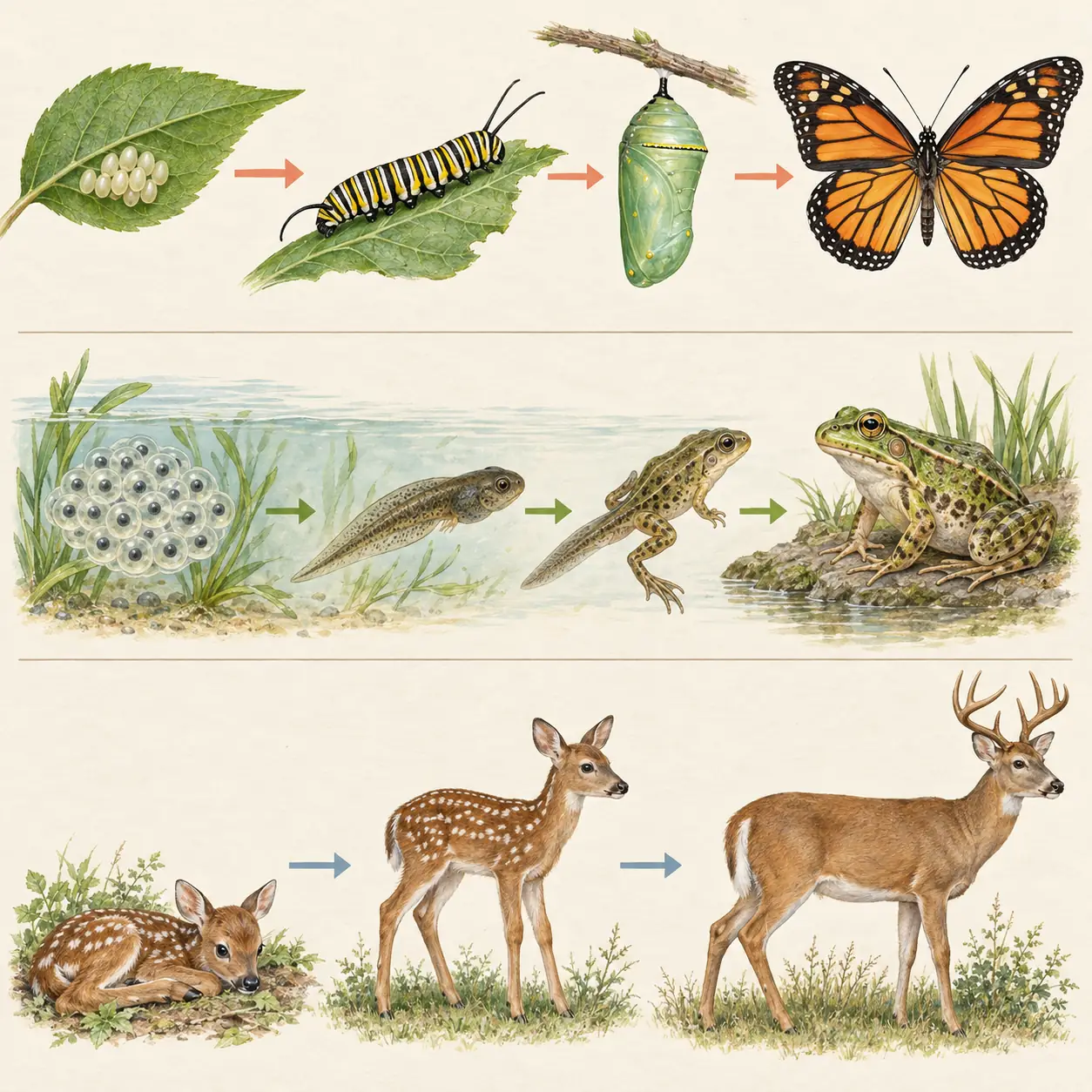
A butterfly begins as an egg laid on or near a host plant. The caterpillar's main job is feeding and growing, so its body and diet differ from the adult's. Inside the pupa, the insect reorganizes into an adult with wings and reproductive organs. The adult feeds, mates, and lays eggs, beginning another complete metamorphosis cycle.
6. Frog: egg, tadpole, froglet, adult
Frog eggs usually develop in water. Tadpoles use a tail and gills or gill-like structures while they grow, then legs and lungs develop during metamorphosis. A froglet gradually absorbs its tail and moves toward the adult body plan. Water quality, temperature, food, and shelter affect survival at different stages.
7. Bird: egg, hatchling, juvenile, adult
A bird embryo develops inside an egg, then a hatchling relies on parental warmth or care. Feathers, flight muscles, beak shape, and feeding skills develop during the juvenile stage. Some birds leave the nest before they can fly well, while others remain dependent longer. The adult stage adds reproduction, nesting behavior, and seasonal movement in some species.
8. Mammal: gestation, birth, juvenile, adult
Most mammals develop inside a parent before birth, although the length of gestation and the amount of parental care vary greatly. A newborn may depend on milk, warmth, and protection, then gain movement and feeding skills. The adult can reproduce, but social learning and physical growth may continue after sexual maturity. A mammal life cycle is direct development, not a claim that all mammals grow at the same speed.
Why life cycle stages and habitats change
Stage names are only the beginning. The useful question is what each stage can do, where it can survive, and how the change supports the next part of the cycle.
9. Different stages can use different habitats
A frog may need a pond as a tadpole and damp vegetation as an adult. A butterfly larva depends on a host plant, while the adult may visit flowers across a wider area. Protecting one stage's habitat does not automatically protect every stage. A life cycle view makes those connections visible.
10. Food changes with body structure
A caterpillar has chewing mouthparts suited to leaves, while an adult butterfly uses a proboscis for liquids. Tadpoles often graze or filter small particles, whereas adult frogs catch prey. These shifts reduce direct competition between stages and help one species use more than one resource in the same ecosystem.
11. Timing is shaped by weather and resources
Temperature, rainfall, daylight, plant growth, and prey availability can change when eggs hatch or young become independent. A textbook sequence may look fixed, but wild populations can vary by year and location. Describe the general pattern first, then add the conditions that shift its timing.
12. Life cycles connect populations to food webs
Eggs, larvae, juveniles, and adults can each be food for different predators. A seasonal pulse of insects or fish may feed many other animals, while a missing breeding site can reduce the next generation. This is why life cycle explanations pair naturally with habitat and animal food chain topics.
How to compare animal life cycles clearly
A comparison is strongest when it uses the same questions for every species. This method works for a school project, a field note, or a quick animal life cycle for kids explanation.
13. Ask what starts the cycle
Record whether the animal hatches from an egg, is born alive, or begins life through another species-specific process. Then note where that beginning happens and what protection or care is available. The starting point often explains why the first habitat is important.
14. Mark the biggest change in body form
For a butterfly, the pupa marks a major reorganization. For a frog, the change from tadpole to froglet is the key transition. For a bird or mammal, growth is more gradual. Naming the largest change makes a diagram easier to understand than listing stages without explaining them.
15. Compare independence and reproduction separately
An animal may leave a nest or find food before it is fully grown. Sexual maturity can arrive before maximum body size, and social learning can continue after reproduction begins. Use separate notes for independence, physical maturity, and reproductive maturity instead of treating them as one date.
16. Keep the species and source beside the claim
Life cycle timing differs among species and regions. Write the common name plus the scientific name when a precise report needs it, and record whether the information comes from a museum, university, conservation group, or textbook. This prevents a fact about one butterfly or frog from being presented as a rule for every animal.
How to check an animal life cycle claim
Search results often compress a complicated sequence into a colorful diagram. Use these steps when a classroom answer, social post, or worksheet leaves out important context.
- 1
Name the species
Replace a broad label such as bird or insect with a species or a clearly described group. Life cycle timing and stages are not identical across a whole class.
- 2
Check the stage definitions
Confirm whether the source uses larva, nymph, juvenile, hatchling, froglet, or adult in the same way you do. A vocabulary mismatch can make two accurate diagrams look contradictory.
- 3
Look for habitat and timing
Ask where each stage lives, what it eats, and what conditions trigger the transition. These details reveal whether a simplified claim leaves out a necessary stage.
- 4
Prefer a first-party science source
Use a museum, university extension, government wildlife agency, or peer-reviewed reference for a final report. Use an engaging worksheet as a starting point, then verify its facts.
A simple animal life cycle activity
Choose a butterfly, frog, bird, and mammal. Draw four columns labeled beginning, young stage, adult stage, and next generation. For each animal, add one body change, one food or habitat need, and one question that still needs a source. The comparison makes the shared pattern visible while preserving the differences that make biology interesting.
For a quick review, use the random animal generator to choose a new species, then test whether your four-column model still works. If it does not, add a stage or explain why the species follows a different pattern. The goal is a more accurate question, not a forced template.
- Draw arrows between stages and label the largest body change.
- Add one habitat need for eggs, young, and adults.
- Separate independence, maturity, and reproduction in your notes.
- Link each surprising claim to a source before publishing it.
Animal life cycle FAQ
What is an animal life cycle?
An animal life cycle is the sequence of growth, development, reproduction, and aging that describes an individual and connects it to the next generation. The stages and timing depend on the species.
Do all animals have the same life cycle stages?
No. Animals share broad needs such as growth and reproduction, but their stages differ. Butterflies have a pupa, frogs have a tadpole and froglet phase, and mammals usually develop directly into a recognizable juvenile form.
What is the difference between direct development and metamorphosis?
Direct development keeps the basic body plan recognizable as the young animal grows. Metamorphosis includes a major body-form change, often with a larval stage and, in complete metamorphosis, a pupa.
What is a simple animal life cycle for kids?
A kid-friendly model can show beginning, young stage, adult stage, and next generation. Add one body change and one habitat need for each stage, then explain that real species may have extra stages or different timing.
Why do animal life cycles matter in a habitat?
Different stages need different food, shelter, water, and temperatures. A habitat that supports adults but loses a breeding site or juvenile refuge can still interrupt the next generation.
Where can I verify a life cycle of animals diagram?
Check a natural history museum, university extension, government wildlife agency, or another clearly cited science source. Confirm the species, stage definitions, habitat, and timing before using a simplified diagram in a report.