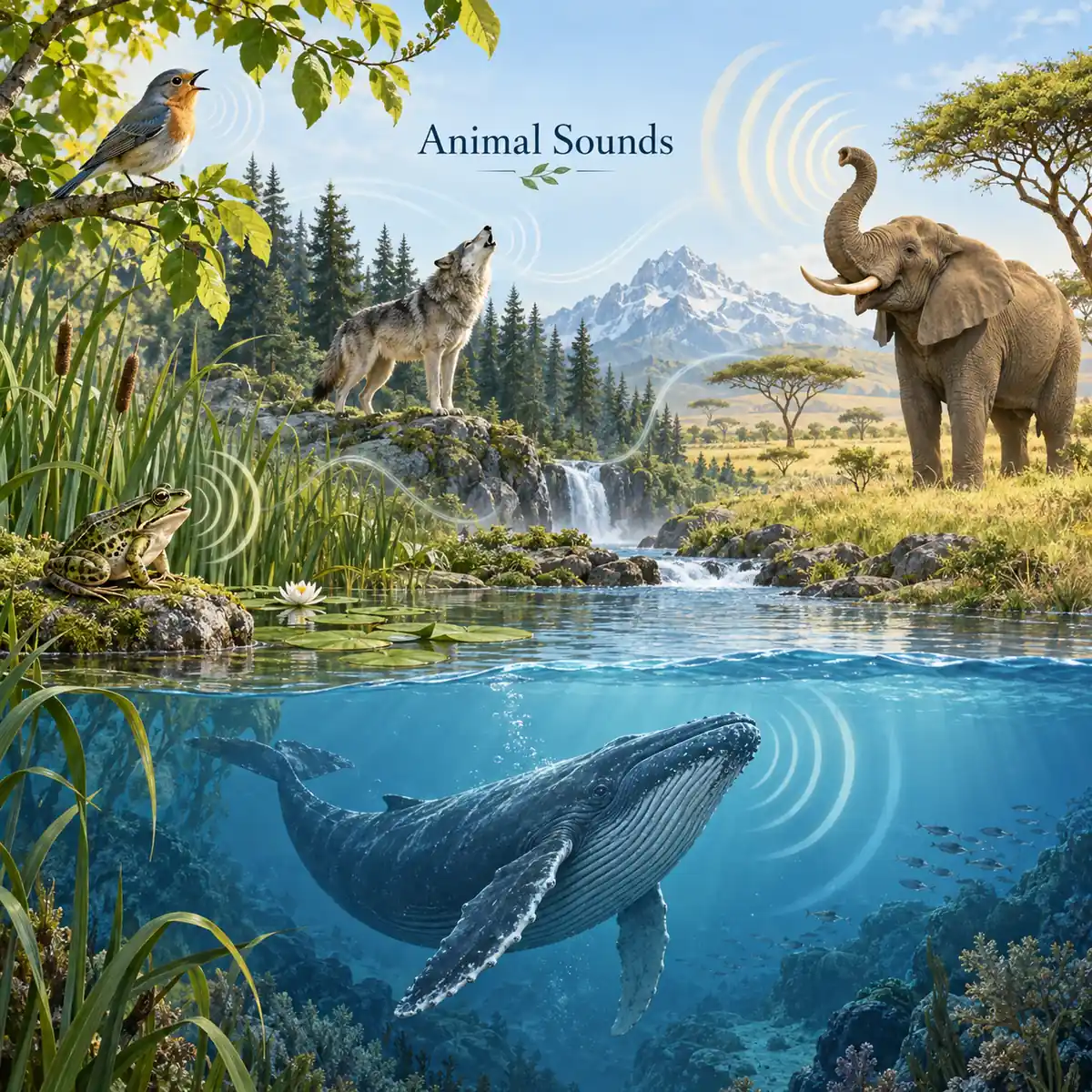
Animal sounds carry information, not just volume
An animal sound is useful when another animal can detect it and respond. A wolf howl may help a pack keep contact over distance, while a frog call can advertise a territory near a pond. A bird song can attract a mate or tell a rival that a nesting area is occupied. The sound itself is only part of the message: timing, repetition, pitch, distance, and the listener all change its meaning.
There is no single universal animal language. A cow moo, a dog bark, and a whale song are convenient human labels for complex signals. Some sounds are learned, some are largely inherited, and many are shaped by the animal's body and habitat. Use the tables below as a starting list, then keep the species and situation in view when you explain what a call means.
Animal sounds list at a glance
These familiar names are useful for a vocabulary activity, but they are not complete translations of an animal's communication system. The same species can use several call types.
| Animal | Common sound word | What to remember |
|---|---|---|
| Dog | bark, whine, howl | Context changes the meaning. |
| Cat | meow, purr, hiss | Friendly, defensive, and contact sounds differ. |
| Cow | moo | Cattle also use quiet contact calls. |
| Horse | neigh, whinny | Calls can signal contact or excitement. |
| Lion | roar, growl | Low sounds can carry across open ground. |
| Bird | sing, chirp, call | Songs and calls often have different jobs. |
| Frog | croak, call | Males often call near breeding water. |
| Whale | sing, click, whistle | Species and population matter. |
Common animal sounds and what the words describe
Sound words make a memorable entry point for children and language learners. They should be treated as human approximations rather than exact recordings of every call.
Dogs bark, whine, and howl
A bark can alert, greet, or interrupt play. A whine may appear during contact, stress, anticipation, or a request. Howling can help dogs communicate over distance, and some dogs join in with sirens or other long sounds. The situation, posture, and repetition are more informative than the word bark by itself.
Cats meow, purr, hiss, and yowl
Domestic cats use meows especially often around people, while purring can occur during calm contact and in some uncomfortable situations. Hissing is a defensive warning. A yowl may be linked to mating, conflict, disorientation, or a need for attention, so the label alone cannot diagnose what a cat feels.
Cattle moo and keep contact
A moo is a broad human spelling for several cattle vocalizations. Calves and mothers may call to one another, and adults can change the timing or tone of a call when separated from a group. The useful lesson is that farm-animal sounds can carry identity and location information, not just emotion.
Horses neigh, nicker, snort, and squeal
A loud neigh can travel across a pasture when a horse is looking for another horse. A soft nicker is often a close-range contact sound, while a snort or squeal can appear during alertness or social tension. Individual experience and the immediate herd context still matter.
Lions roar and use quieter signals
A lion's roar can advertise presence and help members of a pride locate one another. Growls, grunts, moans, and visual signals fill in other social jobs at shorter range. Describing every lion sound as a roar hides the difference between long-distance advertising and close contact.
Birds sing and call
Bird song is often associated with territory or courtship, while a call may keep a flock together, warn of danger, or identify a parent. The boundary is not rigid: species use many sound types, and both males and females may vocalize. Season, age, and social setting change the pattern.
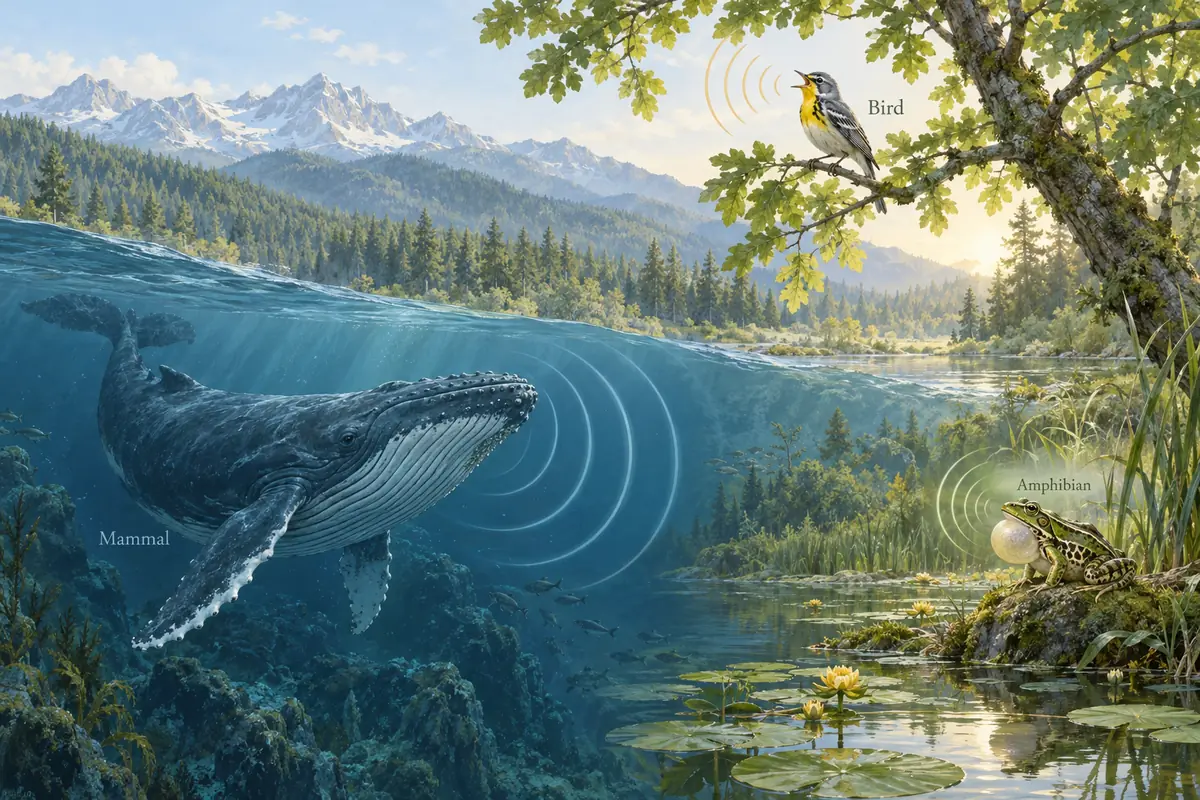
How mammals, birds, amphibians, and insects make sound
The animal's body sets the raw material for a sound, while the habitat determines how far it travels and which listeners can detect it.
Mammals use vocal folds, air, and resonance
Many mammals push air through a voice box and shape the result with the mouth, nose, throat, or body cavities. The size and tension of those structures influence pitch and tone. Some mammals also add body movement, scent, or posture because a sound rarely carries the whole message.
Birds use a syrinx rather than a mammal-style larynx
A bird's syrinx sits where the windpipe divides toward the lungs. Muscles can control the two sides with unusual precision, allowing some birds to produce layered notes or rapid changes. The exact ability differs by species, and a human label such as song does not reveal how the sound is produced.
Frogs call with an expandable vocal sac
Many frogs push air between the lungs and mouth while a vocal sac amplifies the call. A pond or wetland can become a chorus because the sound is useful for finding mates and spacing out callers. Temperature, water level, season, and species identity all change when and how frogs call.
Insects may use wings, legs, or body surfaces
Crickets rub body parts together to create chirps, while some cicadas use vibrating membranes. A grasshopper can stridulate with a leg and wing. These sounds can attract mates or warn competitors, and the high frequency may be easier for an insect to hear than for a human listener.
Whales and dolphins use water as a sound pathway
Toothed whales use clicks and whistles for echolocation and social contact. Many baleen whales produce low, powerful calls that travel through water. Sound moves differently underwater than in air, so distance, depth, background noise, and the species' hearing range affect what another animal receives.
Some animals communicate above and below human hearing
Elephants can produce low-frequency rumbles, while bats use ultrasonic calls for echolocation. Humans may detect only part of these signals without special equipment. A quiet-looking animal is not necessarily silent, and an audible sound is not necessarily the most important part of its communication.
What animal sounds mean in real situations
A useful explanation connects a call to a listener, a setting, and a likely response instead of assigning one fixed translation.
Contact calls keep a group connected
Parents and young animals may exchange calls when vegetation, darkness, distance, or water separates them. Flock and herd members also use short signals to maintain spacing. The sound may be quiet because it is meant for nearby listeners, not for every animal in the habitat.
Alarm calls change the listener's next move
An alarm call can make a group freeze, flee, look toward a predator, or gather around a defended young animal. Different species respond to different risks, and some calls are specific enough to distinguish a predator type. Avoid claiming that every loud call is an alarm.
Courtship sounds advertise identity and condition
Bird songs, frog calls, insect chirps, and mammal displays can help a potential mate locate the right species or judge territory. Weather, age, competition, and the individual's condition can change the performance. A catchy human sound word is not evidence that the animal is happy or sad.
Territorial sounds help animals avoid costly fights
A roar, song, or call can signal that a territory is occupied. If a rival recognizes the signal, the animals may keep distance instead of fighting. This is why pitch, timing, and repetition can matter as much as loudness.
Learned sounds show that communication can be flexible
Some birds, whales, bats, and social mammals learn parts of their vocal behavior from companions. Learning does not mean every call is invented from scratch: anatomy, development, and species history still constrain the range. Researchers compare recordings and behavior over time to separate copying from coincidence.
Human noise can interfere with animal communication
Roads, boats, aircraft, and machinery can mask calls or force animals to change timing and volume. A quiet recording does not prove that an animal stopped communicating. When you discuss conservation, name the habitat and species because the effect of noise is not identical everywhere.
How to verify an animal sound claim
Online clips often attach a dramatic story to a short recording. Use the following checks before turning a sound into a worksheet, quiz answer, or science fact.
- 1
Name the species
A sound attributed to a lion, frog, or whale may actually belong to a related species. Keep the common name and, when possible, the scientific name.
- 2
Check the source context
Look for the location, date, recording conditions, and whether the audio was edited, slowed, or mixed with other sounds.
- 3
Separate call type from emotion
Terms such as alarm, contact, mating, and territorial describe a research-supported function, not a human feeling.
- 4
Compare expert references
Museums, universities, wildlife agencies, acoustic databases, and conservation groups are better starting points than an unlabeled clip.
- 5
Keep uncertainty visible
Use may, often, in some populations, or researchers suggest when the evidence depends on species, season, or habitat.
Five useful ways to use animal sounds
For children, start with a small animal sounds list and ask two questions: who is the listener, and what might the caller need? This moves the activity beyond imitating a moo or roar. Older students can compare how a frog, bird, and whale use different bodies and habitats to send signals.
For a creative prompt, use the Animal Randomizer to choose a species, then research one real call before writing a scene or drawing a creature. Keep the factual note separate from the imaginative part. A made-up animal can borrow a communication problem, but it should not be presented as a real sound record.
- Make a matching game with animals and sound words.
- Sort calls into contact, alarm, courtship, and territory.
- Compare air and water as sound environments.
- Use a random animal as a research and drawing prompt.
- Ask students to add a source and a caveat to every surprising claim.
Animal sounds FAQ
What are the most common animal sounds?
People often recognize a dog bark, cat meow, cow moo, horse neigh, lion roar, bird song, frog croak, and whale song. Each label covers several real call types, so the species and situation still matter.
Why do animals make different sounds?
Animals make different sounds because calls can serve different jobs, such as contact, alarm, courtship, territory, or navigation. Anatomy, habitat, distance, and the listener shape which signal works best.
What is the difference between animal sounds and animal noises?
The phrases overlap in everyday speech. Animal sound is the broader neutral term, while noise can mean any unwanted or uncontrolled sound. In a science explanation, name the call type and function when the evidence allows it.
Why do kids learn animal sounds?
Matching an animal to its sound builds vocabulary, listening, memory, and early classification skills. It becomes more meaningful when children also discuss who hears the call and what response it may trigger.
Can humans hear every animal sound?
No. Some animals use frequencies below or above ordinary human hearing. Elephants can produce infrasound and bats use ultrasonic calls, while recording equipment can reveal signals people would otherwise miss.
Are animal sounds the same in every country?
The animal's biological signal is not translated into a human language, but people write it differently. A rooster may be written as cock-a-doodle-doo in English and with another convention elsewhere. The spelling is cultural; the call is biological.